Thursday, November 22, 2007

Oil and Gasoline Prices: The Crack Spread

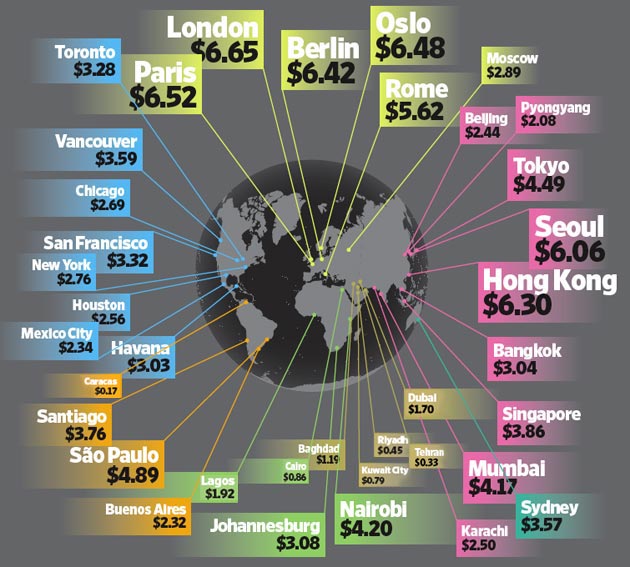
When a major US refinery shuts down, why do oil prices go up? This is counterintuitive. After all, a shut-in refinery means reduced demand for oil, and less demand should mean less price pressure, right? Wrong. Here's an account of the strange ties between oil and gasoline prices. By the way, I could not find the original source of the excellent graphic above, although I know it comes from this blog.

By Peter McKenzie-Brown

The Question of Collusion: Motorists often express concern – call it anger, sometimes – about rising gasoline prices. Citing the reality that neighbouring service stations charge almost identical prices for gasoline, many consumers claim that oil companies illegally collaborate with each other to manipulate gasoline prices. It has frequently been shown, though, that market forces keep local prices the same. If a service station on one street corner charges a penny more per litre than its competitor across the street, motorists will buy from the competitor. It is in each dealer’s self-interest to match the competition’s price.

Economists have no trouble with this explanation of how companies set gasoline prices. It is nonetheless understandable how identical local pump prices cause motorists to suspect collusion by the oil companies – especially when those companies often raise gasoline prices, almost simultaneously, at the beginning of a holiday! Raising prices in anticipation of strong holiday demand is a marketing tactic, however, and not collusion.

Links between Oil and Gasoline Prices: The oil industry’s critics also argue that companies move gasoline prices up quickly when crude oil prices rise, but fail to bring them down when oil prices falter. This argument is also flawed, as a review of the ties between crude oil and gasoline prices in 2006 helps illustrate.

In the week of August 6, the average OPEC crude oil price hit what was then an all-time high: US$71.33 per barrel. That week Canada’s average price of gasoline also reached a peak, at $1.15 per litre. Compared to their averages during the previous two weeks, prices for both commodities rose by about 5 per cent. The following week, OPEC oil and gasoline prices dropped – in both cases, by about 5 per cent. By the week of October 1, which preceded Canada’s Thanksgiving holiday, OPEC oil had dropped by 22 per cent. However, the average price of gasoline for that week had declined to 86 cents – a drop of 27 per cent from its peak price two months earlier. Oil and gasoline prices do track each other, but they are also influenced by other factors. The most important are crude oil prices and taxes.

Refining Problems and Gasoline Prices: In North America there has been a price disconnect between oil and gasoline in recent years. This is partly because the market for gasoline has been strong. This has worsened the limitations in America’s capacity to refine enough gasoline for its consumers.

Canada’s refining centres are at or near Vancouver; Edmonton; Sarnia and Nanticoke, Ontario; Montreal; and St. John, New Brunswick. There are also some smaller refining centres – notably Regina, Saskatchewan and Come-by-Chance, Newfoundland.

Canadians ordinarily produce more than enough gasoline for domestic use. We sometimes import gasoline because refineries need regular maintenance shutdowns or have unexpected operating problems. As the following chart illustrates, our imports are offset by exports to the United States.

The graph also illustrates the seasonal nature of gasoline consumption – we buy far more in the summer than in the winter – and the fact that Canada produces far more gasoline than we consume. Canada exports significant volumes of gasoline, primarily from refineries in Atlantic Canada to the U.S. eastern seaboard. Each year, Canadians consume more than 40 billion litres of gasoline and 25 billion litres of diesel fuel. The bar on the far right of the chart shows Canada becoming a large net-importer of gasoline – for the first time in recent history – in May and June 2006. This occurred because the industry needed to modify many refineries to meet new refining standards. These shutdowns reduced gasoline production just as summer driving was ready to begin, and Canada had to import large volumes to meet demand.

During that summer, motorists witnessed higher, more volatile prices than they had in a long time. Canada was extremely vulnerable to unplanned refinery outages. That brief experience was a small reflection of a large, chronic problem in the United States, and America’s problems affect gasoline prices across the continent.

American Vulnerability: The US has become highly vulnerable to refinery shutdowns, and gasoline prices have developed a volatility that reflects both oil price movements and problems in the refining industry. To some extent, this vulnerability and volatility have splashed across the border into Canada. Gasoline is increasingly a global commodity.

Americans consume about 1.51 billion litres of gasoline every day. The United States is thus the largest gasoline consumer in the world, but it is also the largest refiner. The United States does not produce enough gasoline to meet its own needs, however. It always needs imports, and imported gasoline can be expensive.

“Turnarounds” (scheduled maintenance programs) at US refineries put pressure on international gasoline supply, including supply from Canada. But in recent years unexpected breakdowns at refineries have added urgency to the challenge of meeting consumer needs. These events and stronger demand during the summer driving season contribute to higher prices.

As a rough average, in recent years the US refining sector has operated at 90 per cent of capacity. Put another way, 10 per cent of US refineries have been out of operation at any given time. In that environment, imagine what happens when one or two refineries shut down, reducing capacity use to 89 per cent, say. In a tightly balanced gasoline market, this can cause steep and rapid price increases – something the world witnessed dramatically in 2005, as Hurricane Katrina shut down refineries and closed ports that could have imported gasoline from overseas. The panic that followed briefly took Canadian prices to an all-time high of $1.26 per litre.

A Spiral in Gasoline and Crude Oil Prices: One of the oddest phenomena in the present world of gasoline pricing is its impact on the price of crude oil. As this article has explained, it is logical for gasoline prices to go up along with oil prices. After all, refiners manufacture gasoline from crude oil, and rising input costs contribute to rising total costs.

However, higher gasoline prices also result in higher oil prices. This is less intuitive, for a number of reasons. If a large refinery shuts down, it is reasonable to expect gasoline prices to rise. Less gasoline will be produced, lowering supply; prices will therefore increase. Since there would be less demand for oil to refine, one would normally expect crude oil prices to drop. What actually occurs, however, is the opposite: When a big North American refinery shuts down, both gasoline and oil prices rise. Welcome to the world known to traders as “crack spreads”. “Crack spreads” refers to the spread, or margin, that a refinery can earn by “cracking” (refining) a barrel of oil into such marketable products as gasoline, jet fuel and heating oil. Roughly speaking, three barrels of West Texas oil can be refined into two barrels of gasoline and one barrel of heating oil. If these products rise in value, the value of the barrel of oil they come from will also increase, even if refinery demand for oil has dropped. Thus an off-the-wall oil price spiral: rising crude oil prices increase the price of gasoline, and rising gasoline prices increase the price of oil.

Changing Dynamics: This article has reviewed many factors that are changing the dynamics of gasoline pricing. These factors include rising oil prices. Also, some taxes climb in response to escalating fuel costs, and this further complicates the issue of rising gasoline prices.

We are becoming increasingly reliant on gasoline as our society changes, and there are inefficiencies in the North American petroleum infrastructure that – because petroleum refining and marketing is such a huge industry – will take a long time to strengthen. Of course, this begs the question of whether the oil would be there to supply a larger, more efficient refining sector. That's a question for another day.

Thursday, November 01, 2007

Pricing the Marginal Barrel of Oil


The large-scale exporting nations and regions that are increasing government take from oil – or have already nationalized their oil resources – include Russia, much of the Middle East, Venezuela and other countries. The five countries whose production is charted here are not particularly friendly to the West.
By Peter McKenzie-Brown Five of the world’s large oil exporters have two things besides big oil reserves in common. First, their economies are largely dependent on revenues from energy production – they don’t produce much else. Second, their people or their governments (or both) are hostile to the West.

The chart shows the relative positions of five of the world’s large producers – Venezuela, Russia, Iran, Nigeria and Saudi Arabia. Consider the context: the planet consumes about 85 million barrels a day. Together, these five countries produce more than one third of world supply. Except for post-Soviet Russia, which is new to the game, each of these countries long ago found ways to maximize government revenue from petroleum. Perversely, in the long run this will serve them well by making less production available. As prices rise, their economies will boom long after their production has gone into decline. As the world nears its petroleum peak, the economic reality of a seller’s market will have strange, unintended consequences.

Economic Dependency: Consider the first of the two points I raised. The countries named in the chart have little to keep their economies going except revenue from oil and gas. Here are the numbers. The info comes from many sources, but I’ve done my best to keep it consistent.
• Nigeria: Oil exports provide 20 per cent of GDP, 95 per cent of foreign exchange earnings, and about 65 per cent of budgetary revenues. No reliable export numbers available; Nigeria’s OPEC quota is 2.3 million barrels per day.
• Saudi Arabia: the petroleum sector accounts for roughly 75 per cent of budget revenues, 45 per cent of GDP, and 90 per cent of export earnings. Oil exports are 8.5 million barrels. Saudi’s official OPEC quota is 10.1 million barrels per day.
• Iran: Petroleum exports of 2.8 million barrels per day represent 80 per cent of exports. Exports: 2.8 million barrels per day; the country’s OPEC quota is 4.1 million barrels per day.
• Venezuela: Oil revenues account for roughly 90 per cent of export earnings, more than 50 per cent of federal revenue, and around 30 per cent of GDP. Oil exports are about 2.3 million barrels per day – well short of Venezuela’s OPEC quota of 3.2 million barrels per day.
• Russia: Oil, natural gas, metals, and timber account for more than 80 per cent of exports and 32 per cent of government revenues. Each day, Russia exports some 7 million barrels of oil. It is not a member of OPEC.

No matter how much they protest the importance of oil at “reasonable” levels, these countries are delighted when the price of the marginal barrel of oil – that is, the price of the last barrel sold – goes up. Higher marginal prices enable them to charge more for the barrels they load onto tankers. Nothing new here. However, at a recent energy conference in London, Sadad Al-Husseini – an oil consultant and former executive at Saudi Arabia’s national oil company - made an observation that puts the reality of this economic dependency in an interesting light. In effect, he quantified the price of the marginal barrel when he suggested that supply shortages will add $12 to the price for every million barrels a day of additional global demand.
As this chart of eight major oil-consuming nations illustrates, it isn’t hard to see where increases in world oil consumption will come from. Just watch China and India grow.
Of course, supply and demand are parts of the same equation. Let’s assume that $12 is the cost of adding another million barrels of demand. It would also be the price of subtracting a million barrels of supply. Cutting supply by one million barrels a day would jack prices up by $12 per barrel as effectively as would increasing demand by that amount. While the marginal price is increasing from a growing Asia, it could also increase because of reductions in supply.

If the five producing countries I have been discussing were to cut supply by a million barrels per day, we would likely see yet a price increase of the same magnitude. Consider the math: Today’s marginal barrel is worth about $90. If our five countries collectively reduced production by 5 per cent, their revenue per barrel would increase by 15 per cent, as oil rose to $102 per barrel. Their collective revenues would benefit quite nicely, thank you very much. How could such a reduction occur? These countries wouldn’t need an OPEC agreement to reduce production – you may have noticed that none of the OPEC members are producing their full quotas anyhow. They could effectively reduce production through failure to explore for and develop reserves, by shoddy production practices, by simple government fiat, or as a result of the natural depletion of their reservoirs. Supply could also drop as a consequence of war, insurgency or terrorism. Whatever the cause, the result would be that countries with little else to offer could increase government coffers and national wealth.


Hostility to the West: At the beginning of this post, I noted that each of these countries has a certain amount of hostility to the west, and each in its special way.
 • In the case of Nigeria, part of the issue is an insurgency in which local entrepreneurs have found that taking westerners hostage can be a good source of income. A major oil exporter, the country is also hobbled by political instability, corruption, lousy infrastructure and worse management. Oil is frequently stolen from production facilities, and whole fields shut down after rebel attacks.
 • Saudi Arabia? Officially, the princelings love the West and will do everything they can to maintain supply. Their subjects have other ideas, though. You may remember that fifteen of the September 11 hijackers were Saudi nationals. The land of the fanatical Wahhabist sect of Islam has some real issues with the decadence of the West.
 • Iran’s mullahs can’t understand why anyone would be concerned about their peaceful nuclear program, and would just love to nuke anyone who questions their nuclear rights. George Bush recently announced that if they get nuclear weapons, it will lead to World War Three.
 • Hugo Chavez is selling gasoline in Caracas for 3 cents a litre (part of his socialist reform), while running a country fuelled by crude oil exports. And he’s confiscating the assets of well-managed western oil companies in the interest of owning and operating those assets locally.
 • Then there is newly-belligerent Russia. Incredibly popular and riding the wave of high oil prices, Vladimir Putin wants Russia to become a superpower again. And his control of energy can help him achieve that goal. His country is already an energy superpower. Putin has briefly cut off the taps to both Ukraine and Georgia in recent years, using the energy weapon to settle political scores. He does much more than talk.


Greedy Government Redux: In a recent post, I discussed last week’s changes to Alberta’s royalty regime. As I pointed out, during periods of high oil prices, governments get greedy. In Canada we experienced the disastrous National Energy Program due to the greed of our federal government in the early 1980s. Now, the provincial government of Alberta is at the trough. My basic assumption is that the spectre of peak oil is imminent. As a result, and because of high prices, governments around the world are increasing their take from oil and gas. Alberta is by no means alone in this. Increased government take does not increase oil production – in practice, it decreases the incentive and ability for oil companies to bring more oil on stream. Less production, higher prices: it's a simple matter of supply and demand. In a response to my article, a correspondent told me that “The sooner we get away from the dirty polluting tar sands, the better it will be for the environment and the people of this planet.”

I think that if the 1,250,000 daily barrels of oil that now come from Canada's oil sands suddenly evaporated, you and I would both be dealing with oil well beyond $100 per barrel, right now. Most consumers in the West can pay the extra money for gasoline that such an increase in oil prices would generate, although most of us have had to tighten our belts to do so. However, rising prices are already causing a great deal of suffering around the world – especially in the poorer countries. The world is hooked on oil, which is not good. However, as long as we are hooked, we must find ways to keep those supplies of oil coming while we look for solutions. Increased government take makes it more difficult to develop supply. Increased take by countries whose governments or people are openly hostile to the West is a danger we cannot resolve, but it is also a danger we must not ignore.