 Chiang Mai University’s Language Institute building officially opened today, with a traditional Thai blessing. A clutch of ochre-clad monks blessed the building with Pali and Thai chants and other rituals. (Much as Latin is the classical language of Catholicism, Pali is the classical language of Theravada Buddhism, to which almost all Thai Buddhists subscribe.)
When the religious celebration was over, there was a brief but dignified secular ceremony to open the ultra-modern, 60-million baht complex. Among the small number of dignitaries were university president Dr. Pongsak Angkasith and Dr. Tanun Anumanrajadhon, chairman of the institute’s board. The ceremony was well organized, brief and pleasant. The voices of choice were English and Thai.
In addition to 35 air-conditioned classrooms, Chiang Mai University's Language Institute has a 200-seat theatre, two 100-seat lecture halls and two other large lecture halls with 60 seats each. The complex has a specialized language library, two language labs and a self-access learning centre.
Confucius Institute: Then it was time for the opening of the Confucius Institute, an affiliated organization. Confucius Institutes are China’s answer to the British Council, Alliance Française and Germany’s Goethe Institutes. Their purpose is to spread the study of Mandarin and Chinese culture. The main sponsor of Chiang Mai’s Confucius Institute is the government of China. Other participants include Yunnan Normal University and China’s National Office for Teaching Chinese as a Foreign Language.
So far there are few of these institutes. The first was established in Uzbekistan in 2004. A year ago, according to a published report, there were 25, located in the United States, Europe and Asia. Today, there are more 123, and they are in 49 countries and regions on every populated continent. In 2006, China set one up every three and a half days, on average.
The Confucius Institute pulled out all the stops for this event. The Chinese ambassador to Thailand, Zhang Jiuhuan, spoke at length about the purposes of the Institute, and a mandarin from Beijing – Zhao Guocheng, elaborated. Then the chairman of Yunnan Normal’s academic committee talked warmly about his university’s partnership with CMU.
To make a point, perhaps, the only languages spoken were Mandarin and Thai. The ironic exception occurred when the ambassador ended his speech with an unaccented, perfectly nuanced “Thank you very much,” in English; a slip of the tongue. When the talking was over, curtains fell away and a traditional dragon dance began.
Great Power: One could not help but be impressed with the energy, drive and determination the Chinese applied to this official opening - qualities available in abundance in that emerging superpower. The Confucius Institutes are clearly an important part of Chinese policy, and the country is using its extraordinary ability to get things done to push these organizations as far and as quickly as they can.
I saw the importance the Chinese placed on the opening of this start-up educational organization as emblematic of a Chinese challenge to the dominance of English as the global language. As that country transforms itself into the world’s second economic superpower, it seems to want to develop the linguistic infrastructure that befits a great power.
According to Michael Vatikiotis, “China's national office for teaching Chinese as a foreign language, which runs the Confucius Institutes, will provide textbooks for schools in Southeast Asia with the catchy title ‘Happy Chinese.’” That same national office believes there will be 100 million people worldwide learning Chinese as a foreign language by the year 2010.
Vatikiotis adds, “All of this is a sign of expanding Chinese soft power. But what are the implications of the spread of Chinese language and culture? It's a more important question in a region like Southeast Asia where as many as half the people living in urban areas like Bangkok are of Chinese descent.”
It is an important question indeed. In a way, it epitomizes the struggles within and among languages that are taking place around the world, and which this blog has discussed in some detail elsewhere.
For Chiang Mai University, today's celebrations helped open a building. For China, they helped open the world.
Chiang Mai University’s Language Institute building officially opened today, with a traditional Thai blessing. A clutch of ochre-clad monks blessed the building with Pali and Thai chants and other rituals. (Much as Latin is the classical language of Catholicism, Pali is the classical language of Theravada Buddhism, to which almost all Thai Buddhists subscribe.)
When the religious celebration was over, there was a brief but dignified secular ceremony to open the ultra-modern, 60-million baht complex. Among the small number of dignitaries were university president Dr. Pongsak Angkasith and Dr. Tanun Anumanrajadhon, chairman of the institute’s board. The ceremony was well organized, brief and pleasant. The voices of choice were English and Thai.
In addition to 35 air-conditioned classrooms, Chiang Mai University's Language Institute has a 200-seat theatre, two 100-seat lecture halls and two other large lecture halls with 60 seats each. The complex has a specialized language library, two language labs and a self-access learning centre.
Confucius Institute: Then it was time for the opening of the Confucius Institute, an affiliated organization. Confucius Institutes are China’s answer to the British Council, Alliance Française and Germany’s Goethe Institutes. Their purpose is to spread the study of Mandarin and Chinese culture. The main sponsor of Chiang Mai’s Confucius Institute is the government of China. Other participants include Yunnan Normal University and China’s National Office for Teaching Chinese as a Foreign Language.
So far there are few of these institutes. The first was established in Uzbekistan in 2004. A year ago, according to a published report, there were 25, located in the United States, Europe and Asia. Today, there are more 123, and they are in 49 countries and regions on every populated continent. In 2006, China set one up every three and a half days, on average.
The Confucius Institute pulled out all the stops for this event. The Chinese ambassador to Thailand, Zhang Jiuhuan, spoke at length about the purposes of the Institute, and a mandarin from Beijing – Zhao Guocheng, elaborated. Then the chairman of Yunnan Normal’s academic committee talked warmly about his university’s partnership with CMU.
To make a point, perhaps, the only languages spoken were Mandarin and Thai. The ironic exception occurred when the ambassador ended his speech with an unaccented, perfectly nuanced “Thank you very much,” in English; a slip of the tongue. When the talking was over, curtains fell away and a traditional dragon dance began.
Great Power: One could not help but be impressed with the energy, drive and determination the Chinese applied to this official opening - qualities available in abundance in that emerging superpower. The Confucius Institutes are clearly an important part of Chinese policy, and the country is using its extraordinary ability to get things done to push these organizations as far and as quickly as they can.
I saw the importance the Chinese placed on the opening of this start-up educational organization as emblematic of a Chinese challenge to the dominance of English as the global language. As that country transforms itself into the world’s second economic superpower, it seems to want to develop the linguistic infrastructure that befits a great power.
According to Michael Vatikiotis, “China's national office for teaching Chinese as a foreign language, which runs the Confucius Institutes, will provide textbooks for schools in Southeast Asia with the catchy title ‘Happy Chinese.’” That same national office believes there will be 100 million people worldwide learning Chinese as a foreign language by the year 2010.
Vatikiotis adds, “All of this is a sign of expanding Chinese soft power. But what are the implications of the spread of Chinese language and culture? It's a more important question in a region like Southeast Asia where as many as half the people living in urban areas like Bangkok are of Chinese descent.”
It is an important question indeed. In a way, it epitomizes the struggles within and among languages that are taking place around the world, and which this blog has discussed in some detail elsewhere.
For Chiang Mai University, today's celebrations helped open a building. For China, they helped open the world.
Showing posts with label second language. Show all posts
Showing posts with label second language. Show all posts
Monday, December 18, 2006
Confucius and the Language Institute
By Peter McKenzie-Brown
 Chiang Mai University’s Language Institute building officially opened today, with a traditional Thai blessing. A clutch of ochre-clad monks blessed the building with Pali and Thai chants and other rituals. (Much as Latin is the classical language of Catholicism, Pali is the classical language of Theravada Buddhism, to which almost all Thai Buddhists subscribe.)
When the religious celebration was over, there was a brief but dignified secular ceremony to open the ultra-modern, 60-million baht complex. Among the small number of dignitaries were university president Dr. Pongsak Angkasith and Dr. Tanun Anumanrajadhon, chairman of the institute’s board. The ceremony was well organized, brief and pleasant. The voices of choice were English and Thai.
In addition to 35 air-conditioned classrooms, Chiang Mai University's Language Institute has a 200-seat theatre, two 100-seat lecture halls and two other large lecture halls with 60 seats each. The complex has a specialized language library, two language labs and a self-access learning centre.
Confucius Institute: Then it was time for the opening of the Confucius Institute, an affiliated organization. Confucius Institutes are China’s answer to the British Council, Alliance Française and Germany’s Goethe Institutes. Their purpose is to spread the study of Mandarin and Chinese culture. The main sponsor of Chiang Mai’s Confucius Institute is the government of China. Other participants include Yunnan Normal University and China’s National Office for Teaching Chinese as a Foreign Language.
So far there are few of these institutes. The first was established in Uzbekistan in 2004. A year ago, according to a published report, there were 25, located in the United States, Europe and Asia. Today, there are more 123, and they are in 49 countries and regions on every populated continent. In 2006, China set one up every three and a half days, on average.
The Confucius Institute pulled out all the stops for this event. The Chinese ambassador to Thailand, Zhang Jiuhuan, spoke at length about the purposes of the Institute, and a mandarin from Beijing – Zhao Guocheng, elaborated. Then the chairman of Yunnan Normal’s academic committee talked warmly about his university’s partnership with CMU.
To make a point, perhaps, the only languages spoken were Mandarin and Thai. The ironic exception occurred when the ambassador ended his speech with an unaccented, perfectly nuanced “Thank you very much,” in English; a slip of the tongue. When the talking was over, curtains fell away and a traditional dragon dance began.
Great Power: One could not help but be impressed with the energy, drive and determination the Chinese applied to this official opening - qualities available in abundance in that emerging superpower. The Confucius Institutes are clearly an important part of Chinese policy, and the country is using its extraordinary ability to get things done to push these organizations as far and as quickly as they can.
I saw the importance the Chinese placed on the opening of this start-up educational organization as emblematic of a Chinese challenge to the dominance of English as the global language. As that country transforms itself into the world’s second economic superpower, it seems to want to develop the linguistic infrastructure that befits a great power.
According to Michael Vatikiotis, “China's national office for teaching Chinese as a foreign language, which runs the Confucius Institutes, will provide textbooks for schools in Southeast Asia with the catchy title ‘Happy Chinese.’” That same national office believes there will be 100 million people worldwide learning Chinese as a foreign language by the year 2010.
Vatikiotis adds, “All of this is a sign of expanding Chinese soft power. But what are the implications of the spread of Chinese language and culture? It's a more important question in a region like Southeast Asia where as many as half the people living in urban areas like Bangkok are of Chinese descent.”
It is an important question indeed. In a way, it epitomizes the struggles within and among languages that are taking place around the world, and which this blog has discussed in some detail elsewhere.
For Chiang Mai University, today's celebrations helped open a building. For China, they helped open the world.
Chiang Mai University’s Language Institute building officially opened today, with a traditional Thai blessing. A clutch of ochre-clad monks blessed the building with Pali and Thai chants and other rituals. (Much as Latin is the classical language of Catholicism, Pali is the classical language of Theravada Buddhism, to which almost all Thai Buddhists subscribe.)
When the religious celebration was over, there was a brief but dignified secular ceremony to open the ultra-modern, 60-million baht complex. Among the small number of dignitaries were university president Dr. Pongsak Angkasith and Dr. Tanun Anumanrajadhon, chairman of the institute’s board. The ceremony was well organized, brief and pleasant. The voices of choice were English and Thai.
In addition to 35 air-conditioned classrooms, Chiang Mai University's Language Institute has a 200-seat theatre, two 100-seat lecture halls and two other large lecture halls with 60 seats each. The complex has a specialized language library, two language labs and a self-access learning centre.
Confucius Institute: Then it was time for the opening of the Confucius Institute, an affiliated organization. Confucius Institutes are China’s answer to the British Council, Alliance Française and Germany’s Goethe Institutes. Their purpose is to spread the study of Mandarin and Chinese culture. The main sponsor of Chiang Mai’s Confucius Institute is the government of China. Other participants include Yunnan Normal University and China’s National Office for Teaching Chinese as a Foreign Language.
So far there are few of these institutes. The first was established in Uzbekistan in 2004. A year ago, according to a published report, there were 25, located in the United States, Europe and Asia. Today, there are more 123, and they are in 49 countries and regions on every populated continent. In 2006, China set one up every three and a half days, on average.
The Confucius Institute pulled out all the stops for this event. The Chinese ambassador to Thailand, Zhang Jiuhuan, spoke at length about the purposes of the Institute, and a mandarin from Beijing – Zhao Guocheng, elaborated. Then the chairman of Yunnan Normal’s academic committee talked warmly about his university’s partnership with CMU.
To make a point, perhaps, the only languages spoken were Mandarin and Thai. The ironic exception occurred when the ambassador ended his speech with an unaccented, perfectly nuanced “Thank you very much,” in English; a slip of the tongue. When the talking was over, curtains fell away and a traditional dragon dance began.
Great Power: One could not help but be impressed with the energy, drive and determination the Chinese applied to this official opening - qualities available in abundance in that emerging superpower. The Confucius Institutes are clearly an important part of Chinese policy, and the country is using its extraordinary ability to get things done to push these organizations as far and as quickly as they can.
I saw the importance the Chinese placed on the opening of this start-up educational organization as emblematic of a Chinese challenge to the dominance of English as the global language. As that country transforms itself into the world’s second economic superpower, it seems to want to develop the linguistic infrastructure that befits a great power.
According to Michael Vatikiotis, “China's national office for teaching Chinese as a foreign language, which runs the Confucius Institutes, will provide textbooks for schools in Southeast Asia with the catchy title ‘Happy Chinese.’” That same national office believes there will be 100 million people worldwide learning Chinese as a foreign language by the year 2010.
Vatikiotis adds, “All of this is a sign of expanding Chinese soft power. But what are the implications of the spread of Chinese language and culture? It's a more important question in a region like Southeast Asia where as many as half the people living in urban areas like Bangkok are of Chinese descent.”
It is an important question indeed. In a way, it epitomizes the struggles within and among languages that are taking place around the world, and which this blog has discussed in some detail elsewhere.
For Chiang Mai University, today's celebrations helped open a building. For China, they helped open the world.
Chiang Mai University’s Language Institute building officially opened today, with a traditional Thai blessing. A clutch of ochre-clad monks blessed the building with Pali and Thai chants and other rituals. (Much as Latin is the classical language of Catholicism, Pali is the classical language of Theravada Buddhism, to which almost all Thai Buddhists subscribe.)
When the religious celebration was over, there was a brief but dignified secular ceremony to open the ultra-modern, 60-million baht complex. Among the small number of dignitaries were university president Dr. Pongsak Angkasith and Dr. Tanun Anumanrajadhon, chairman of the institute’s board. The ceremony was well organized, brief and pleasant. The voices of choice were English and Thai.
In addition to 35 air-conditioned classrooms, Chiang Mai University's Language Institute has a 200-seat theatre, two 100-seat lecture halls and two other large lecture halls with 60 seats each. The complex has a specialized language library, two language labs and a self-access learning centre.
Confucius Institute: Then it was time for the opening of the Confucius Institute, an affiliated organization. Confucius Institutes are China’s answer to the British Council, Alliance Française and Germany’s Goethe Institutes. Their purpose is to spread the study of Mandarin and Chinese culture. The main sponsor of Chiang Mai’s Confucius Institute is the government of China. Other participants include Yunnan Normal University and China’s National Office for Teaching Chinese as a Foreign Language.
So far there are few of these institutes. The first was established in Uzbekistan in 2004. A year ago, according to a published report, there were 25, located in the United States, Europe and Asia. Today, there are more 123, and they are in 49 countries and regions on every populated continent. In 2006, China set one up every three and a half days, on average.
The Confucius Institute pulled out all the stops for this event. The Chinese ambassador to Thailand, Zhang Jiuhuan, spoke at length about the purposes of the Institute, and a mandarin from Beijing – Zhao Guocheng, elaborated. Then the chairman of Yunnan Normal’s academic committee talked warmly about his university’s partnership with CMU.
To make a point, perhaps, the only languages spoken were Mandarin and Thai. The ironic exception occurred when the ambassador ended his speech with an unaccented, perfectly nuanced “Thank you very much,” in English; a slip of the tongue. When the talking was over, curtains fell away and a traditional dragon dance began.
Great Power: One could not help but be impressed with the energy, drive and determination the Chinese applied to this official opening - qualities available in abundance in that emerging superpower. The Confucius Institutes are clearly an important part of Chinese policy, and the country is using its extraordinary ability to get things done to push these organizations as far and as quickly as they can.
I saw the importance the Chinese placed on the opening of this start-up educational organization as emblematic of a Chinese challenge to the dominance of English as the global language. As that country transforms itself into the world’s second economic superpower, it seems to want to develop the linguistic infrastructure that befits a great power.
According to Michael Vatikiotis, “China's national office for teaching Chinese as a foreign language, which runs the Confucius Institutes, will provide textbooks for schools in Southeast Asia with the catchy title ‘Happy Chinese.’” That same national office believes there will be 100 million people worldwide learning Chinese as a foreign language by the year 2010.
Vatikiotis adds, “All of this is a sign of expanding Chinese soft power. But what are the implications of the spread of Chinese language and culture? It's a more important question in a region like Southeast Asia where as many as half the people living in urban areas like Bangkok are of Chinese descent.”
It is an important question indeed. In a way, it epitomizes the struggles within and among languages that are taking place around the world, and which this blog has discussed in some detail elsewhere.
For Chiang Mai University, today's celebrations helped open a building. For China, they helped open the world.


Saturday, December 09, 2006
The Great Motivators

I recently updated my book, Teach and Leorn: Reflections on Communicative Language Teaching, from which this is a chapter, and made it available on Kindle and as an inexpensive book. To enjoy a read, please click here.
By Peter McKenzie-Brown
For teachers, four key factors affect the rate at which a student learns a second language. (I am referring to external factors. Although they clearly have roles to play, such considerations as attitude, aptitude and previous experience in language learning don't count in the context of this discussion.)
The most important factor relates to the student's primary motivation. Language theorists often describe a language student's primary form of motivation as either instrumental or integrative motivation.
Instrumental motivation is the weaker form. Common among those learning English, for example, with no intention of ever living in a country like Britain or Canada, instrumental motivation is the prime mover of those who want to learn a language as a tool for some secondary purpose – talking to tourists, for example. Integrative motivation is a greater force. It is the motivation of those who are learning a second language in a new country, and they are learning the language so they can integrate into a new society.
The second fundamental factor affecting language learning is the amount of time the student spends in class and practicing the language. Generally speaking, more motivated students spend more time; less motivated students, less.
The third factor is the teacher’s approach (for example, communicative language teaching or audiolingualism) to language teaching. The fourth is the instructor's teaching effectiveness and style.
You can probably see a big problem here. The myth of the great teacher whose motivational abilities inspire her students to world-shattering achievements is essentially flawed. I think of this as the paradox of motivation. The student's main motivator - integrative or instrumental motivation - is the one factor the teacher essentially has no control over. And that motivation drives the second most important factor behind student success, time spent on task.
What's a teacher to do? Accept this reality, and develop your ability to motivate students in secondary ways. Primary motivation notwithstanding, the teacher's motivational skills are still critical for both learning and teaching.
Good teachers use many teaching qualities to motivate students. These include a combination of variation and structure in teaching activities. They find ways to show the practical value of learning English. They encourage and nurture their students, and many excellent teachers also bring sympathy and empathy into the classroom. They make the physical teaching space as compatible with learning as they can. They offer tools for learning (for example, mnemonics) and they conduct the class in a fair and balanced way. They also provide the students with consistency and fairness, and they do everything they can to help the students feel safe.
What TEFL teachers think: In a recent class, I discussed this problem with my TEFL (teaching English as a foreign language) students, and asked them to brainstorm ways to motivate their students. They concluded that there are five areas where the teacher can really make a difference: in their lesson plans, in classroom management, in teaching style, in testing and assessment and in professional development. By no means were their ideas exhaustive, but they were good. Here is a summary.
1. Create great lesson plans: Choose great topics. Provide interesting and varied activities. Develop medium-term class themes. Have attainable goals and objectives, which provide real challenges but seek progress, not perfection. KISS (Keep it short and simple). And use authentic materials and situations for classroom teaching.
2. Classroom management: Attend to your students’ comfort and convenience. Find ways to visually represent class progress. Set up the classroom effectively and use equipment as effectively as you can.
3. Teaching style: Your teaching style consists of attitude, presence and rapport. Here are some comments on each.
• Attitude: Know your students’ names. Activate their prior knowledge and nurture their abilities. Be knowledgeable and authoritative, but modest. Be passionate about teaching. Be punctual. Dress and groom professionally.
• Presence: Empathize with your students. Enable your students to have fun. Show your personality, and vary the ways you teach
• Rapport: Appeal to different learning styles, especially kinaesthetic. Be conscious and respectful of your students’ culture or cultures. Give genuine praise and recognition. Involve the students in their learning; for example, use KWL (“what you know, what you want to know, what you have learned”) charts to develop and measure class content. Offer appropriate counsel and advice.
4. Assessment: Give your students good and regular assessment and testing. Get them to help each other. Monitor the class through feedback, and use prizes as rewards from time to time.
5. Professional development: Keep a log of your classroom performance, on occasion get someone to video your performance, and periodically ask a colleague or friend to assess your teaching. And take advantage of whatever professional development training you can get your hands on. We can always improve, and we must.

Monday, December 04, 2006
The Value of Testing
I recently updated my book, Teach and Leorn: Reflections on Communicative Language Teaching, from which this is a chapter, and made it available on Kindle and as an inexpensive book. To enjoy a read, please click here.
By Peter McKenzie-Brown
Students hate tests, and so do teachers. For the student, they are a pain to study for and a worry to take. For the teacher, they are a nuisance to give and a bother to grade. But research shows that failing to give tests is bad educational practice. This is because if you test your students, they will probably better retain the material you are presenting. And oddly enough, they can do so without studying more or harder.
The Testing Effect: The journal Psychological Science noted this outcome in a 2006 report. According to the researchers, “Taking a memory test not only assesses what one knows, but also enhances later retention, a phenomenon known as the testing effect.” They added, “Testing is a powerful means of improving learning, not just assessing.”
Oddly enough, tested students can actually do better with less study. According to a media report,
….students who relied on repeated study alone frequently developed a false sense of confidence about their mastery of the materials even while their grasp of important detail was sliding away. By comparison, students who were either tested repeatedly or tested themselves while revising scored dramatically higher marks. A group of students who read a piece of text 14 times, for example, recalled less than a self-testing group who had read the piece only three or four times.
Now, let’s move from the immediate findings of this research to the realm of common sense. Teachers have long known that testing plays a key role in teaching and learning.
Self-tests in language promote retention, while process-focused tests (for example, writing a journal or preparing to give an oral presentation) activate language. Testing has many other uses. Through testing, both teacher and learner get a better sense of the student’s progress. They encourage students to self-evaluate and they promote autonomy in learning. We can use them to provide a sense of closure to a unit or a course of study. They can give your students a better sense of where their competence has improved, and they can give you feedback on how effective you are as a teacher.
Traditional and Alternative Assessments: Traditional forms of testing fall into four basic categories. (1) Proficiency tests give general information on student language proficiency level. They are not specific to any particular program. (2) Placement tests are designed to be appropriate for a specific program. These tests should reflect the goals and ability levels in the program and help you place students within the program. (3) Achievement tests, which should be part of every language curriculum, should be specific to the goals and objectives of a specific language course. (4) Finally, diagnostic tests focus on individual student’s strengths and weaknesses. You can use information from diagnostic tests to help your students improve in particular areas of weakness.
There are many ways to create standard tests for language students. They are commercially available, and many schools have files of hoary old tests you can borrow or emulate. A frequently raised concern about these tests is the question of whether they have validity (they measure what they are supposed to measure); reliability (the tests are consistent); and objectivity (the assessment is unbiased). In terms of this discussion, those are issues for another day.
From the communicative language teaching perspective, a more pressing weakness of traditional testing is that it is neither communicative nor authentic. Given the importance of assessment as a teaching aid, however, it is worth looking at alternative ways to test foreign language students. For language learners more than for other learners, perhaps, alternatives are particularly important.
There are four obvious forms of alternative assessment. Observe your students, writing notes in student records. Meet with them. Have them write journals. And have them create portfolios of their work. These are just a sample, however, and they are not systematic. For system, consider a review by Jo-Ellen Tannenbaum.
The Alternatives: The American educator wrote a commentary on alternative assessment. She pictures the landscape in these words:
Many educators have come to recognize that alternative assessments are an important means of gaining a dynamic picture of students' academic and linguistic development. “Alternative assessment refers to procedures and techniques which can be used within the context of instruction and can be easily incorporated into the daily activities of the school or classroom”. It is particularly useful with (language) students because it employs strategies that ask students to show what they can do. In contrast to traditional testing, “students are evaluated on what they integrate and produce rather than on what they are able to recall and reproduce”. Although there is no single definition of alternative assessment, the main goal is to “gather evidence about how students are approaching, processing, and completing real-life tasks in a particular domain”.
Alternative assessments, she added, generally meet the following criteria:
• Focus is on documenting individual student growth over time, rather than comparing students with one another.
• Emphasis is on students' strengths (what they know), rather than weaknesses (what they don't know).
• Consideration is given to the learning styles, language proficiencies, cultural and educational backgrounds, and grade levels of students.
In her thoughtful article, Tannenbaum puts alternative assessments into five categories. The first she calls “non-verbal assessment strategies”, in which students use physical demonstration or pictures, for example, to illustrate their comprehension.
A second is the KWL chart. The initials refer to “what I know/what I want to know/what I've learned”, and she advocates using this tool to begin and end a unit of study. In an EFL class, you might begin by surveying students on their course expectations. At various points in the course, you could then assess what they know and what they are learning. At the end of the unit, you can work with the students to determine how much they have learned of what they wanted to know.
Tannenbaum also suggests oral performances or presentations as alternative forms of testing. “Performance-based assessments include interviews, oral reports, role plays, describing, explaining, summarizing, retelling, paraphrasing stories or text material, and so on.” Other possibilities include role play and oral presentations. She adds that oral assessments should be conducted regularly so you can monitor your students’ comprehension and thinking skills.
A fourth cluster of alternatives includes what she calls “oral and written products.” She suggests that the teacher can assess student progress include “content area thinking and learning logs, reading response logs, writing assignments (both structured and creative), dialogue journals, and audio or video cassettes.”
Finally, she advocates the portfolio of student work, collected over time to track student development. She suggests that portfolios should include a variety of materials -- audio- and videotaped recordings of readings or oral presentations, for example; writing samples and assignments; conference or interview notes and anecdotal records; and tests and quizzes.
Individualized assessment can be a time-consuming task, and it will drift into the realm of the virtually impossible if you ever find yourself with, for example, several large classes of university students. However, the case for assessment is compelling. After all, your responsibility as a teacher is to promote learning among your students, and the much-hated practice of testing can be one of the great tools toward achieving that goal.

Wednesday, November 08, 2006
Up from the Bottom or Down from the Top?

I recently updated my book, Teach and Learn: Reflections on Communicative Language Teaching,
and made it available on Kindle and as an inexpensive paperback. To enjoy a
read, please click here.
Psychology long ago began to debate two views – “top-down interpretation” and “bottom-up processing”– of how we understand language. Although the evidence is ambiguous, researchers generally believe they are distinct but complementary processes. For language instructors, the debate is less important than an appreciation of the roles these parallel processes play in classroom teaching and learning.
This discussion argues that good teaching practice accepts both views of language learning. However, their relative importance largely depends on the skills of the language learner.
To appreciate this, let’s begin with points of view. The advocates of “top-down interpretation” argue that background knowledge and previous experience of a situation, context, and topic play primary roles in helping us interpret meaning. We use prior knowledge and experience to anticipate, predict, and infer meaning. By contrast, the advocates of “bottom-up processing” believe language relies more heavily on decoding the sounds and letters of a language into words, clauses, sentences, and such. We then use our knowledge of grammatical, syntactic and lexical rules to interpret meaning. In this view, language users work from the bottom – the sounds they hear and the letters they encounter – to identify meaning.
To put that broad debate into context, consider that the primary focus of communicative language teaching is to develop communicative competence. CL teachers develop this competence through the use of materials and activities that focus on using language functions – for example, describing people and telling time. Because native-speakers use higher mental schema when they are processing language, language teachers develop activities that will enable their second-language learners to do the same. Broadly speaking, activities of these kinds involve top-down learning skills.
Is this always a good thing? No. Some language teachers are too quick to jump on the top-down bandwagon. In our view, better teachers are those who strike a conscious balance between top-down and bottom-up learning, which both have roles in language instruction.
According to Robert Norris, who uses listening activities to illustrate, “If we…require (our) students to use native speaker processing skills without first giving (them) a firm grounding in decoding the stream of sounds they hear, we run the risk of causing (them) more frustration and confusion than they can handle.”
We will return to Norris’s thoughtful discussion shortly. In the meantime, remember that bottom-up processing is particularly important when learners use the receptive language skills of listening and reading, because it plays a big role in making input comprehensible. And comprehensible input is the engine of effective language acquisition.
Bottom-up…: The bottom-up view assumes that listening is a process of decoding sounds and graphemes (the letters of the alphabet). We start with the smallest units, and gradually decode them until we understand the content of what we are listening to or reading.
The number of micro-skills involved is large. For example, when we listen we discriminate among the distinctive sounds of English, recognize stress patterns and the rhythmic structure of English, and discern how we use stress and intonation to signal information. Also, we need to identify words in stressed and unstressed positions and in reduced forms. We also have to recognize grammatical structures and typical word-order patterns. Meaning and comprehension are the last steps in the decoding process.
When we read, we use the building blocks of language to make meaning of what we see on the printed page. Bottom-up processes include sounds and graphemes -- the representation of sounds by letters. In English this involves word recognition for the countless irregular spellings and a sophisticated system of punctuation. We then need to to process written information through grammar and sentences. From these blocks we build comprehension.
…and Top-down: By contrast, top-down proponents believe that language processing involves the reconstruction of meaning through prior knowledge or “schema.”
Listeners actively reconstruct the original meaning of the speaker using incoming sounds and other signals like body language as clues. Prior knowledge of context and situation enables us to make sense of what we hear. A native speaker, for example, may completely zone out while hearing the news, then snatch a few brief cues that quickly draw him in. Similarly, when we begin a phone conversation to make an appointment, we shift into formal speech-patterns for such situations. This is another instance of schema guiding language use.
We also use schema to help us understand what we are reading. For example, the format of letters, emails and magazine ads are similar from culture to culture. Their format, whether in the reader’s first or second language, provides specific and useful information about what we can be likely to expect. Other top-down skills include surveying, skimming, scanning, reading for full comprehension, reading between the lines (inference), and reacting personally to reading texts. Teaching these learning strategies to your intermediate students can greatly improve their reading comprehension.
The Language Level Issue: In his excellent discussion of top-down and bottom-up teaching, Norris argues that the teaching community’s eagerness to focus on top-down teaching is sometimes misguided. “Many of the listening materials on the market today are concerned chiefly with helping learners become more adept at improving top-down skills by having them (identify relevant information while ignoring unnecessary details.)”
He adds, “In order to simulate the knowledge that native speakers bring to listening, learners are often provided with vocabulary lists prior to the task and told who the speakers are, what the situation is, and what the topic is about. However, scant attention is paid to the phonological characteristics that mark informal speech. This seems a bit like putting the cart before the horse.”
Norris makes a strong case that teachers must develop both bottom-up and top-down skills, especially at the lower levels. “Teachers are asking a lot from their students… when top-down listening tasks are given without first assessing the students' ability to do bottom-up processing.” His argument is sound. Learners need many micro-skills learners for bottom-up processing, and a good teacher neglects them at his peril. This applies especially to beginning and early intermediate students.
Wrap-up: The main conclusion of this discussion is that we need to feed both learning processes when we are teaching our students.
How and when can we use top-down processing? When you are teaching, make sure your students are aware of the format and general content of a reading, for example. Tell them they are going to read a ghost story, for example, and then elicit ideas about what the content might be, what vocabulary might occur, and so on. This switches on the ghost-story schema in their brains, and also begins activating their English skills. You can do the same with listening. Tell them you are about to listen to a sports broadcast on the Football World Cup. Elicit information about football and the vocabulary they might expect to hear, and so on. Also, of course, a CL teacher is constantly using authentic activities to teach. Thus, a role-play “in the restaurant” is by its very nature a top-down comprehension activity.
In these and many other ways, you can take advantage of your students’ ability to use top-down comprehension to get them ready for the upcoming learning activity. As your students advance, you can use more sophisticated top-down schema and strategies.
Bottom-up skills are different. As we have suggested throughout, they are usually more basic and therefore more important for lower-level students. With those students, you need to spend time helping them recognize reduced speech, for example, and irregular spellings. In the early stages of language acquisition, automaticity in word recognition is critical.
Communicative language teaching emulates real-life language acquisition, which means our work has a top-down bias. Your class needs to use authentic activities and materials to function effectively, and those materials tend to be top-down. However, focusing exclusively on top-down teaching creates problems. Especially with beginning students, spend time developing bottom-up skills.

Monday, October 23, 2006
Aural and Oral Skills

I recently updated my book, Teach and Learn: Reflections on
Communicative Language Teaching, and made it available on Kindle and as an
inexpensive paperback. To enjoy a read, please click here.
Please click to download a PDF of my book Teach and Learn: Reflections on Communicative Language Teaching.
The two most basic language skills, listening and speaking, sound exactly alike when we describe them as oral and aural skills. “Aural” language, of course, refers to language as we hear it. “Oral” language is what we say.
These two words are “homophones” – words spelled differently that sound alike. There is no good reason why they should be homophones, but they are. Perhaps that accident of spelling can serve as a reminder that, while these two skills cannot be separated, they need to be developed in different ways.
 Teaching Basic Skills: According to a hoary adage, “We are given two ears and one mouth so we can listen twice as much as we talk.” This is a maxim to remember when we plan our lessons – especially when we are dealing with a classroom of new learners.
 Logically, listening should be the first skill you teach. In practice, however, most teachers get their students talking on the first day of class, and many make speech the major focus of their lessons. They tend to downplay the skill of listening, as do most foreign language textbooks. Yet listening is probably the more important skill involved in foreign language learning, as it certainly is in the acquisition of one’s native tongue.
Stephen Krashen and other thinkers have stressed that we acquire language best by using it in communicative ways. He was also one of the first to stress that language acquisition and language learning are not the same. Language learning (in the sense of making conscious discoveries about grammar, for instance) involves different mental processes, and those processes play distinctly secondary roles to those we use when we acquire language naturally. Language develops, he says, through exposure to and use of “comprehensible input” – target language the learner can understand and assimilate. All of this is textbook Krashen.
One reasonable conclusion from these observations is that language learners should understand what they are listening to before they begin to speak. Especially at the initial phase of language acquisition, teachers should avoid oral practice to some degree. Instead, they should have their students concentrate on comprehending what they hear. This idea parallels the experience of young children, who spend almost two years in linguistic silence before they begin to speak.
To use listening-focused learning, a communicative language teacher needs to incorporate active listening into their classes. This is done with activities in which the learners demonstrate that they understand, and receive gentle correction when they err. More advanced students must be explicitly taught to recognize reduced language forms heard in colloquial speech – as in “Whaddaya say?” Also, of course, part of aural comprehension is learning to decipher nonverbal clues.
Pure listening is rarely a good strategy for sustained language acquisition. Even if students are still in their silent period – a common phase for beginners, in which they speak very little if at all, – teachers should encourage active participation from them. This is the only way to confirm that they have understood. Participation can mean as little as a nod or a headshake, for example, or the words “yes” and “no” in English or their native language. Listening without speaking is important for foreign language learners, especially when their language learning has just begun, but at some level that listening should be participatory.
Listening activities do not always involve some other skill, but they generally do; the best classroom activities cross skill boundaries. Since the most typical pairing for a listening activity is to combine it with speech practice, a focus on listening can actually promote the effective development of speaking skills. To see how, let's turn to the activation of speech.
Focus on Conversation: Speaking activities best occur in classrooms in which learners feel comfortable and confident, free to take risks, and have plenty of opportunities to speak. While there are countless kinds of activities teachers use to develop speaking skills, they most commonly promote conversational speech. This, of course, requires the use of both listening and speaking skills.
Conversational language has four characteristics. It is interactive, in the sense that we talk back and forth in short bursts. Often, we do not even use complete sentences – “nice day, eh?” Conversation also has narrow time limits. We have to listen and respond without the luxury of thinking much about what we want to say. Conversation is also repetitive, in the sense that we tend to use a relatively small amount of vocabulary and a relatively small repertory of language structures.. And finally, of course, it is error-prone. Because of time limits, we may use the wrong word, pronounce something wrong or mangle structure. While we may hear the mistake and back up and correct ourselves, often we don’t.
Bearing in mind the earlier comments about listening, these characteristics of conversation illustrate an important difference between listening activities and speaking activities. Because listening is a learner’s primary source of comprehensible input, aural activities depend heavily on accuracy. To understand, learners must listen carefully, and their comprehension must be good. In many listening activities, we play a short recording of speech repeatedly until we think our learners understand it.
By contrast, learners shift heavily in the direction of fluency during conversation practice, which combines both listening and speaking skills. At this portion of the language class, the teacher kisses student accuracy goodbye. During speaking activities, the focus is on interactive, time-limited, repetitive and error-prone conversation. As is often the case in the language classroom, as we move from skill to skill, or from language study to language activation, we willingly compromise accuracy in the interest of fluency.
The How and Why of Language: Language originated with the two linguistic skills we have just reviewed – listening and speaking. But why? What is the purpose of language? And how did it evolve to play this role in our lives?
Whether we hear it or voice it, the purpose of language is to do the things that speech can do. In no way is it abstract. Like an axe, language is a tool with which we do things.
According to linguistic philosopher J.R. Searle, we use language to perform five kinds of “speech act”. These are commissive, declarative, directive, expressive and representative. Commissive speech commits the speaker to do something – for example, “I promise to bring it tomorrow,” or “Watch out or I will report you.” Declarations change the state of things – “I now pronounce you husband and wife,” or “You’re fired!” Directive speech gets the listener to do something – “Please come in,” “Watch out!” or “Why don’t you take your medicine?” Expressive language explains feelings and attitudes: “Those roses are beautiful,” or “I hate broccoli.” Finally, representative speech describes states or events – “Rice is an important Thai export,” or “The United States is at war again.” All of our speech seems to do one or more of these five things.
Language is such an important part of our lives that we use it to meet virtually all of our daily needs. Consider psychologist Abraham Maslow’s famous hierarchy of needs, which is often illustrated as a pyramid. In Maslow’s model, we can only move to a higher level of need after we have scrambled up the lower levels.
In his view, people have five kinds of need. Our most basic needs are physiological – food and water, for example. The next level up is the need for safety and security, which we achieve, for example, by dealing with emergencies. Tier 3 involves needs for love, affection and belongingness. The need for esteem – self-respect and respect from others – comes next, but the highest level in this hierarchy is the need for self-actualization. According to Maslow, in this last level “A musician must make music, an artist must paint, and a poet must write.” The point of this discussion is that we meet virtually all those needs through speech acts.
The gradual evolution of language has profoundly affected the nature of our species. As Stephen Pinker observes,
Human practical intelligence may have evolved with language (which allows know-how to be shared at low cost) and with social cognition (which allows people to cooperate without being cheated), yielding a species that literally lives by the power of ideas.It is impossible to overstate the value or complexity of language. It is perhaps the most fundamental feature of our lives.

Saturday, October 14, 2006
The Gift of Tongues and The Written Word
I recently updated my book, Teach and Learn: Reflections on Communicative Language Teaching, and made it available on Kindle and as an inexpensive paperback. To enjoy a read, please click here.

By Peter McKenzie-Brown
In the beginning, there were only two language skills: listening and speaking. Language began as an aural/oral process. It has always been associated with visual cues, however (consider the pervasive importance of body language in human encounters}, and those visual cues eventually led to the language skills of reading and writing.
In the West, that process began in ancient Sumer, about 3500 BCE. Oddly enough, reading, writing and arithmetic developed out of early accounting systems, rather than the other way around. Reading and writing extended language in quite an extraordinary way. From a function restricted to ear and mouth, they turned it into one that can also be conveyed by eye and hand.
The gradual development of widespread literacy led to many changes in the human condition. Most notably, it liberated language from the immediacy of the spoken word. Both reading and writing require more time than the aural-oral skills, and they tend to encourage thought. The following lists compare spoken and written language, with item #1 in the first group mirroring item #1 in the second group, and so on.
Listening and Speaking
1. Listening and speaking involve impromptu, informal, colloquial language.
2. Unfamiliar national and regional accents and pronunciation problems cause difficulties in comprehension.
3. Meaning is conveyed by word stress, intonation and body language.
4. Gestures and expressions aid understanding.
5. Speakers speak in real time; listeners participate immediately.
6. People easily develop native-language listening and speaking skills.
7. Speech is essentially impermanent.
Reading and Writing
1. Reading texts tend to be organized, formal and stylized.
2. Alphabets and ideographic-style writing systems (think Chinese writing) vary greatly in complexity and approach.
3. English orthography (spelling) is highly idiosyncratic.
4. Meaning is enhanced through punctuation and writing style.
5. Writers have time for corrections; readers can puzzle out meaning.
6. Learning to read and write requires conscious effort.
7. The printed word is documentation.
To read and write, we need six things. In the balance of this commentary, I will review them, and consider their implications for the English teacher.
The Roman Alphabet: English-language learners need to recognize the letters of the Roman (also called the Latin) alphabet. It is very difficult to understate the impact of this hoary old alphabet on western civilization. According to some theorists, this alphabet uses so few letters to represent words that it helped Westerners become highly analytical, and thus had a huge impact on the western mind and outlook.
The Roman alphabet is the dominant writing system in most of the world. The primary alternatives are the Cyrillic alphabet (used in the former Soviet Union), the Arabic alphabet, the Brahmic alphabets of India and parts of Southeast Asia, and the ideographic systems of China, Korea and Japan. The latter are not alphabets.

Phonics: Also known as the phonetic method, this is a system of teaching children to read. It is commonly used to teach young learners to read in their mother tongue. In this system learners are taught the sounds which the letters represent, and then try to build up the sound of a new or unfamiliar word by saying it one sound at a time.
Phonics can be used for older learners that use either ideographic or non-Latin alphabets. The main difference is that older learners have probably already learned their own writing system, so they will bring to the learning process strategies based on that experience. A useful embellishment on phonics is to have the students spell words out loud as they encounter them in writing. Thus, “ant” is “ay en tee.” This helps develop the students’ ability to remember and recognize the word.
Handwriting and Keyboards: Remember that the printed word is essentially speech produced through our hands. Until recently, the normal progression of things was that we would first learn to write, then move on to cursive writing (rounded script). In recent years, however, cursive has been given short shrift in the West, as youngsters increasingly used keyboards.
Does this matter? According to one observer,
The loss of handwriting … may be a cognitive opportunity missed. The neurological process that directs thought, through fingers, into written symbols is a highly sophisticated one. Several academic studies have found that good handwriting skills at a young age can help children express their thoughts better
Whatever the case, most teachers in Western countries do not spend a great deal of time on cursive writing. EFL teachers are less likely to spend time with their students working on it, except in unusual circumstances. In most cases, to be able to print in English is enough.
It is essential that English-language learners acquire as soon as possible the ability to recognize and produce written words. And since the computer is not going to go away, it is often useful (it depends on class assessment and the nature of the assignment) to insist on typewritten work.
Orthography: Orthography is the fancy work for spelling, and English spelling is more irregular than any other on the planet. As the table below illustrates, the letter combination “ou” can be pronounced in eleven ways, while we can create the “long e” sound with eleven different spellings.
Letters “ou”
tough, tour, dough, famous, bought, you, should,Sound “ee”
journey, loud, flour, cough.
paediatric, me, seat, seem, ceiling, people, chimney,
machine, siege, phoenix, lazy.
When you teach vocabulary, it is critical that you point out irregular spellings. Because of the oddities of accepted English spelling (think “straight” and “protégé”), it is often quite difficult for students – especially those who speak non-European languages – to develop quick word recognition. This requires frequent practice. However, as the following passage illustrates, native speakers with sophisticated language skills can recognize words with great efficiency.
The phaomnneil pweor of the hmuan mnid
Aoccdrnig to rsreeach at Cmabrigde Uinervtisy, it deosn't mttaer in waht oredr the ltteers in a wrod are, the olny iprmoetnt tihng is taht the frist and lsat ltteer be at the rghit pclae. The rset can be a total mses and you can sitll raed it wouthit porbelm. Tihs is bcuseae the huamn mnid deos not raed ervey lteter by istlef, but the wrod as a wlohe. Asbouellty amzanig huh?
Punctuation: What stress and pronunciation do to the melody and rhythm of speech, punctuation does for the written word. Punctuation skills are to reading and writing what phonology is to listening and speaking.
English punctuation is highly sophisticated, and it is difficult to teach. However, consistently and from the beginning you should stress the basics: capitalize the first letter in a sentence, the pronoun “I” and proper names; put a full stop at the end of every sentence; indent paragraphs. The more sophisticated functions (commas, semicolons, colons, dashes, writing schema and so on) come much later.
Inflections and sentence structure: Good writing requires good grammar. In spoken English, fluency is mostly more important than accuracy. In written English, the opposite is true. Good writing requires good grammar. Because readers have time to study and analyse written English, they are more aware of errors in inflection (he walks, he walked), and other features of language structures than when they are in aural/oral mode. The same applies to spelling. Also, grammatically correct structures enable readers to identify parts of speech, and this aids them in their understanding.
A brilliant illustration of the importance of structure in written English can be found in Lewis Carrol’s famous nonsense rhyme, “Jabberwocky.” The story begins,
Twas brillig, and the slithy toves/ Did gyre and gimble in the wabe;
All mimsy were the borogoves,/ And the mome raths outgrabe.
In this poem, all of the content words are meaningless. Yet because Carrol’s grammatical structure is flawless, we have no trouble identifying the parts of speech and the inflections of these nonsense words.
“Toves,” “borogoves” and “raths,” for example, are all plural nouns. The other nonsense words are either adjectives or verbs; indeed, "outgrabe" is clearly an irregular verb in the simple past tense. The one ambiguity in this stanza is the word “brillig”. We don’t know whether it is an adjective or a noun, but in terms of sentence structure it is clearly a complement.
Because of the importance of structure in the written word, when you teach writing you must stress strategies – pre-writing activities, revision, dictionary use, spell-checking and peer review, for example – to help students get their work up to an acceptable standard. You must also, of course, let them know what that standard is.

Wednesday, September 20, 2006
What Research Says about Teaching Methods
I recently updated my book, Teach and Learn: Reflections on Communicative Language Teaching, and made it available on Kindle and as an inexpensive paperback. To enjoy a read, please click here.
By Peter McKenzie-Brown
Educators base their systems of language teaching on language theory. Here is one summary of teaching methods, based on the work of two Canadian educators. In their technical but thoughtful book, Patsy Lightbown and Nina Spada discuss contemporary thinking about how we learn languages, and illustrate how such ideas directly affect the classroom.
Here is a commentary on their five proposals for classroom teaching. The authors describe each method as an imperative the teacher might bring into class.
Grammar Translation and Audiolingualism. A traditional teacher coming into class would insist to her students, “Get it right from the beginning!”
Teachers from both the grammar translation and the audiolingualism schools do this. They emphasize speech, but are reluctant to let their students use it spontaneously. The reason is that they worry about their students forming bad, ugly habits that they cannot break. Since habits are hard to break, it is better to prevent them. Unbreakable habits of speech – they do occur – are said to be “fossilized.”
According to the two Canadians, research does not support the idea that avoiding fossilization by getting it right from the beginning is an effective way to teach. Just the contrary, in fact. In experiments, students learning by this method clearly did better when communicative activities were added to their lessons. That said, many adults prefer these structure-based methods despite their limitations.
Interactionism. The Interactionist view holds that second language learning takes place primarily through talking with other people (“conversational interaction”). When students have meaningful conversations in a second language, both sides of the conversation use behaviours that are quite useful for language learning. Here are some practical examples:
• One partner might make an effort to make sure the other has understood.
• The learner might ask for clarification to make sure he understood.
• The learner may repeat or paraphrase a sentence, to make sure she gets it right.
These are all excellent strategies for language learning, and they lead to the interactionist teacher’s imperative: “Say what you mean and mean what you say!”
This method is based on the idea that, when given the opportunity to engage in meaningful activities, learners will “negotiate for meaning” – clarify and express their intentions, thoughts and opinions in ways that permit them to achieve their learning goals. “Genuine exchanges of information must surely enhance students’ motivation to participate in language learning activities,” the authors say. But then they ask, “Do they…lead to successful language acquisition?” According to the two authors, the research is ambiguous.
Communicative Language Teaching
Lightbown and Spada describe three other methods of classroom teaching, all of which fall generally into the scope of Communicative Language Teaching (CLT). To simplify our review of CLT, it is worth quickly reviewing Stephen Krashen’s theory of second language acquisition.
Krashen’s ideas consist of five main hypotheses:
• The acquisition-learning hypothesis
• The monitor hypothesis
• The natural order hypothesis
• The input hypothesis, and
• The affective filter hypothesis.
As we discussed elsewhere, these ideas seem to describe quite effectively how learners acquire second languages.
Of particular importance, Krashen’s ideas have practical value for the classroom warrior wanting to deliver effective lessons. In the following commentary, I suggest that each of the last three Lightbown and Spada imperatives correspond roughly with one or more of Krashen’s hypotheses.
The Comprehensible Input Hypothesis. The authors describe a radical application of Krashen’s comprehensible input hypothesis in the form of a method of language teaching in which the students “Just listen, and read!” This kind of learning is most likely to take place in a well equipped language lab, where the students use tapes and readings graded to their individual level.
As long as the students are working with language they can comprehend, there is no theoretical reason they cannot acquire a second language. After all, Krashen’s primary thesis is that we can only learn language through comprehensible input. (He adds to this that teachers should stretch their knowledge of the language by providing them with “i+1” encounters – just a tad more of the second language than they can easily understand, to increase their comprehension.)
The “just listen and read” method assumes it is not necessary to drill and memorize language forms. Emphasis is on providing comprehensible input through listening and reading activities. Experimental research has found that this system is effective, but the authors sound a note of caution.
Students develop not only good comprehension (in reading and listening), but also confidence and fluency....However, research does not support the argument that an exclusive focus on meaning in comprehensible input is enough to bring learners to high levels of accuracy in their second language.
Students also need explicit instruction in the forms of language – for example, specific structures. Otherwise, their language skills will remain somewhat limited.
The Natural Order Hypothesis. Lightbown and Spada describe a method which focuses on teaching structural forms, but teaching them in developmental order. Their imperative? “Teach what is teachable!” The concept is that instruction cannot change the ‘natural’ course of development. This is because linguistic structures develop along particular developmental paths. Teaching advanced structures to beginners will not work because the learners do not yet have the ability to process (unconsciously analyse and organise) them.
That, at least, is the theory. As the authors explain, it is difficult to test because the “natural order” of language learning is still unclear. Some things are known – for example, WH questions and Yes/No questions are much easier to acquire than those using question tags (“It’s easy to do, isn’t it?”). However, as a learner begins to reach complicated structures, the difficult language structures are not too well defined.
The Acquisition/Learning Hypothesis. Lightbown and Spada describe one final method. While this course in TEFL finds value in many teaching methods, the authors’ last teaching method is the one we most strongly support. “Get it right in the end!” they say.
This method is the one most in keeping with Krashen’s “monitor model” of second language learning. As our study of Krashen explains, the monitor hypothesis is the idea that conscious learning serves primarily as a monitor or an editor for the language student. It plays a relatively small but necessary role in effective language acquisition, which comes primarily from exposure to comprehensible input and language practice.
The “get it right in the end” method recognizes the importance of explicitly teaching language content – making the study of structure, lexis and phonology a part of language lessons. However, it puts primary emphasis on the idea that students will acquire most language features will be acquired naturally if learners have adequate exposure to the language and a motivation to learn. This view largely agrees with “Teach what is teachable”, but “emphasizes the idea that some aspects of language must be taught and may need to be taught quite explicitly.”
Approach, Method and Technique. All these methods of instruction can play a role in a good language teacher’s toolkit. Communicative Language Teaching is based not on dogma, but on what works to help students learn language effectively. While we believe CLT is the most effective approach to language teaching, we also recognize that is effective because it is eclectic. CLT begins with the idea that the purpose of language learning is to communicate, and uses ideas and practices from any other method if they can help achieve that goal.
CLT is nothing if it is not pragmatic.

Sunday, September 17, 2006
Words, Words, Words
I recently updated my book, Teach and Learn: Reflections on Communicative Language Teaching, and made it available on Kindle and as an inexpensive paperback. To enjoy a read, please click here.
By Peter McKenzie-Brown
 You are studying a foreign language, you want to learn ten new words every day, and the mental task of managing your growing word list seems formidable. To put the job into context, consider the following from linguist Stephen Pinker.
 “Children begin to learn words before their first birthday,” he says, “and by their second they hoover them up at a rate of one every two hours. By the time they enter school children command 13,000 words, and then the pace picks up, because new words rain down on them from both speech and print. A typical high-school graduate knows about 60,000 words; a literate adult, perhaps twice that number.”
Smaller than a toddler’s daily intake, your ten-word vocabulary list suddenly seems like a pauper in a palace. And the problem of properly learning vocabulary involves much more than remembering words. In the classroom, only a few words and a small part of what the learner needs to know about a word can be dealt with at any one time. For the common words, which often have multiple meanings and complex nuances, you can only teach a bit at a time. The more information you present, the more likely your learners are to misunderstand.
For both teacher and learner, vocabulary is a huge challenge. But help is at hand from vocabulary researcher Paul Nation, whose magisterial 480-page tome, Learning Vocabulary in Another Language, offers endless insights into the science and practice of teaching and learning vocabulary. He calls his preferred method of vocabulary teaching the direct approach.
Nation describes vocabulary learning as a “meeting” between the learner and the word, and he stresses that it only makes sense to have close encounters with common, useful words. Most teachers emphasize the most common 2000 English words. The most widely accepted list is available on the Internet by googling Michael West’s General Service List.
“Useful vocabulary needs to be met again and again to ensure it is learned,” Nation says. “In the early stages of learning the meetings need to be reasonably close together, preferably within a few days, so that too much forgetting does not occur. Later meetings can be very widely spaced with several weeks between each meeting.”
There are essentially four ways to learn and teach high-frequency words.
• One is direct teaching, mentioned earlier. For the language teacher, explaining vocabulary is a critical part of classroom duties.
• Also, encourage your students to participate in direct learning, which involves study from word cards and dictionary use.
• A third method, incidental learning, can involve guessing from context in extensive reading or through word use in communicative activities.
• The fourth method Nation calls “planned encounters.” These encounters include vocabulary exercises and graded reading – that is, using reading materials like shortened novels with reduced vocabulary for language learners.(Graded readers are available in many language teaching bookstores.)
Nation’s direct approach to vocabulary teaching is built upon three main ideas. First, vocabulary teaching should focus on high-frequency words that will be of continuing importance for the learners. As a teacher, you have a duty to pass over low-frequency words completely or with little comment. Also, you have to make sure the learners come back to the word frequently, to diminish the power of forgetfulness.
Also, when you teach a word you should focus on its “learning burden” – that is, the features of the word that actually need to be taught. These can differ quite dramatically from word to word. Take the word “think.” You need to explain that it is an irregular verb; that it includes the irregular spelling “thought”; and that “thought” can also be a noun.
Finally, direct teaching should be clear and simple. To learn a word in all its complexity, learners need to meet it many times. Don’t try to teach a complex word – for example, the many meanings of the word “right” – in one sitting. That kind of intensive vocabulary teaching takes place in boring classrooms, and it frequently leads to perplexed students.


Saturday, August 26, 2006
How Persnickety Should the Teacher Be?

There are endless debates among language teachers about how concerned teachers should be with their students’ language output. What is the best balance between the extremes of correcting most of their errors and correcting none? Do we want students to speak accurately, even if doing so limits their ability to use the language easily? Or do we want them to speak more comfortably (that is, fluently), even at the expense of accurate pronunciation and grammar? How persnickety should the teacher be?
There will always be battles between advocates of accuracy and advocates of fluency. However, most Western language teachers now fall into the latter camp, and they are supported by a large body of research and language theory. According to this point of view, there is in inevitable lag between language fluency and language accuracy. As language learners develop greater comfort in using a second language, they become better able to identify and correct their own mistakes. I believe this principle should dominate language acquisition.
If you want to visualize this idea in practice, take a look at the graphic at the beginning of this post. The upper triangle represents teacher talk, which is always accurate; after all, she is usually a native speaker. The teacher begins class by talking (call this “teacher input”). However, the good teacher steadily reduces her own talk time by introducing activities that increase language production by her students (call this “student output.”) Conceptually, the class quickly changes from one in which the teacher does almost all the communication (focus on accuracy) to one in which the students do almost all the talking (focus on fluency).
As is always the case, a good language lesson should go through several stages as you make the transition from accuracy to fluency. It should begin with language study, then continue with activation of the language through controlled, guided and free practice exercises.
Forget about spending endless hours teaching grammar or having your students repeat sentence patterns by rote. Language acquisition takes place most effectively when your students use it in increasingly life-like situations. As the band leader said in auditions, “Don't play me the scales. Play me a damned tune!”
The focus on accuracy is strongest during the language study phase of class. Here the teacher explains some points of grammar, pronunciation or vocabulary, and does most (if not all) of the talking. There’s little possibility of error, because students don’t say much. This stage of the lesson is short, however.
Teachers need to structure their classes in such a way that they say less and less as class rolls on, while the students say more and more. When they do this, students become increasingly active in later stages of class, the “three practices”.
In controlled practice, the teacher remains in control. Student activities are such that it is fairly difficult for them to make errors – and when they do, the teacher’s job is to make corrections. At this stage, teacher input (also known as “teacher talk time”) is about equal to student output (“student talk time”). But student output completely dominates the latter parts of the class. The teacher relaxes control progressively during guided and free practice activities. Sure, your students will make mistakes, but their fluency will improve. And if you design your activities well, your students will correct each other or themselves when challenged.
I haven’t described all the components of an ideal lesson plan, of course. For example, good classes begin with a warm-up, which serves to switch on the students’ second language brains. They also include a stage often referred to as “engagement” – a few minutes of class in which the teacher catches student interest and generates excitement about the upcoming topic of study.
These notes are barely more than the sketch of a notion, but the basic idea is strong. Let accuracy go in the interest of fluency. If you do, the odds are you will see immediate improvements in your students’ classroom performance.
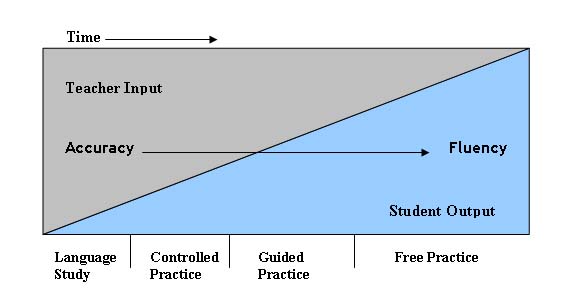
Subscribe to:
Posts (Atom)