 Chiang Mai University’s Language Institute building officially opened today, with a traditional Thai blessing. A clutch of ochre-clad monks blessed the building with Pali and Thai chants and other rituals. (Much as Latin is the classical language of Catholicism, Pali is the classical language of Theravada Buddhism, to which almost all Thai Buddhists subscribe.)
When the religious celebration was over, there was a brief but dignified secular ceremony to open the ultra-modern, 60-million baht complex. Among the small number of dignitaries were university president Dr. Pongsak Angkasith and Dr. Tanun Anumanrajadhon, chairman of the institute’s board. The ceremony was well organized, brief and pleasant. The voices of choice were English and Thai.
In addition to 35 air-conditioned classrooms, Chiang Mai University's Language Institute has a 200-seat theatre, two 100-seat lecture halls and two other large lecture halls with 60 seats each. The complex has a specialized language library, two language labs and a self-access learning centre.
Confucius Institute: Then it was time for the opening of the Confucius Institute, an affiliated organization. Confucius Institutes are China’s answer to the British Council, Alliance Française and Germany’s Goethe Institutes. Their purpose is to spread the study of Mandarin and Chinese culture. The main sponsor of Chiang Mai’s Confucius Institute is the government of China. Other participants include Yunnan Normal University and China’s National Office for Teaching Chinese as a Foreign Language.
So far there are few of these institutes. The first was established in Uzbekistan in 2004. A year ago, according to a published report, there were 25, located in the United States, Europe and Asia. Today, there are more 123, and they are in 49 countries and regions on every populated continent. In 2006, China set one up every three and a half days, on average.
The Confucius Institute pulled out all the stops for this event. The Chinese ambassador to Thailand, Zhang Jiuhuan, spoke at length about the purposes of the Institute, and a mandarin from Beijing – Zhao Guocheng, elaborated. Then the chairman of Yunnan Normal’s academic committee talked warmly about his university’s partnership with CMU.
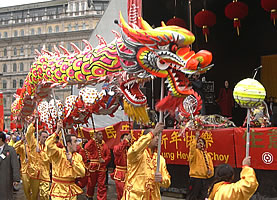
To make a point, perhaps, the only languages spoken were Mandarin and Thai. The ironic exception occurred when the ambassador ended his speech with an unaccented, perfectly nuanced “Thank you very much,” in English; a slip of the tongue. When the talking was over, curtains fell away and a traditional dragon dance began.
Great Power: One could not help but be impressed with the energy, drive and determination the Chinese applied to this official opening - qualities available in abundance in that emerging superpower. The Confucius Institutes are clearly an important part of Chinese policy, and the country is using its extraordinary ability to get things done to push these organizations as far and as quickly as they can.
I saw the importance the Chinese placed on the opening of this start-up educational organization as emblematic of a Chinese challenge to the dominance of English as the global language. As that country transforms itself into the world’s second economic superpower, it seems to want to develop the linguistic infrastructure that befits a great power.
According to Michael Vatikiotis, “China's national office for teaching Chinese as a foreign language, which runs the Confucius Institutes, will provide textbooks for schools in Southeast Asia with the catchy title ‘Happy Chinese.’” That same national office believes there will be 100 million people worldwide learning Chinese as a foreign language by the year 2010.
Vatikiotis adds, “All of this is a sign of expanding Chinese soft power. But what are the implications of the spread of Chinese language and culture? It's a more important question in a region like Southeast Asia where as many as half the people living in urban areas like Bangkok are of Chinese descent.”
It is an important question indeed. In a way, it epitomizes the struggles within and among languages that are taking place around the world, and which this blog has discussed in some detail elsewhere.
For Chiang Mai University, today's celebrations helped open a building. For China, they helped open the world.
Chiang Mai University’s Language Institute building officially opened today, with a traditional Thai blessing. A clutch of ochre-clad monks blessed the building with Pali and Thai chants and other rituals. (Much as Latin is the classical language of Catholicism, Pali is the classical language of Theravada Buddhism, to which almost all Thai Buddhists subscribe.)
When the religious celebration was over, there was a brief but dignified secular ceremony to open the ultra-modern, 60-million baht complex. Among the small number of dignitaries were university president Dr. Pongsak Angkasith and Dr. Tanun Anumanrajadhon, chairman of the institute’s board. The ceremony was well organized, brief and pleasant. The voices of choice were English and Thai.
In addition to 35 air-conditioned classrooms, Chiang Mai University's Language Institute has a 200-seat theatre, two 100-seat lecture halls and two other large lecture halls with 60 seats each. The complex has a specialized language library, two language labs and a self-access learning centre.
Confucius Institute: Then it was time for the opening of the Confucius Institute, an affiliated organization. Confucius Institutes are China’s answer to the British Council, Alliance Française and Germany’s Goethe Institutes. Their purpose is to spread the study of Mandarin and Chinese culture. The main sponsor of Chiang Mai’s Confucius Institute is the government of China. Other participants include Yunnan Normal University and China’s National Office for Teaching Chinese as a Foreign Language.
So far there are few of these institutes. The first was established in Uzbekistan in 2004. A year ago, according to a published report, there were 25, located in the United States, Europe and Asia. Today, there are more 123, and they are in 49 countries and regions on every populated continent. In 2006, China set one up every three and a half days, on average.
The Confucius Institute pulled out all the stops for this event. The Chinese ambassador to Thailand, Zhang Jiuhuan, spoke at length about the purposes of the Institute, and a mandarin from Beijing – Zhao Guocheng, elaborated. Then the chairman of Yunnan Normal’s academic committee talked warmly about his university’s partnership with CMU.
To make a point, perhaps, the only languages spoken were Mandarin and Thai. The ironic exception occurred when the ambassador ended his speech with an unaccented, perfectly nuanced “Thank you very much,” in English; a slip of the tongue. When the talking was over, curtains fell away and a traditional dragon dance began.
Great Power: One could not help but be impressed with the energy, drive and determination the Chinese applied to this official opening - qualities available in abundance in that emerging superpower. The Confucius Institutes are clearly an important part of Chinese policy, and the country is using its extraordinary ability to get things done to push these organizations as far and as quickly as they can.
I saw the importance the Chinese placed on the opening of this start-up educational organization as emblematic of a Chinese challenge to the dominance of English as the global language. As that country transforms itself into the world’s second economic superpower, it seems to want to develop the linguistic infrastructure that befits a great power.
According to Michael Vatikiotis, “China's national office for teaching Chinese as a foreign language, which runs the Confucius Institutes, will provide textbooks for schools in Southeast Asia with the catchy title ‘Happy Chinese.’” That same national office believes there will be 100 million people worldwide learning Chinese as a foreign language by the year 2010.
Vatikiotis adds, “All of this is a sign of expanding Chinese soft power. But what are the implications of the spread of Chinese language and culture? It's a more important question in a region like Southeast Asia where as many as half the people living in urban areas like Bangkok are of Chinese descent.”
It is an important question indeed. In a way, it epitomizes the struggles within and among languages that are taking place around the world, and which this blog has discussed in some detail elsewhere.
For Chiang Mai University, today's celebrations helped open a building. For China, they helped open the world.
Showing posts with label world languages. Show all posts
Showing posts with label world languages. Show all posts
Monday, December 18, 2006
Confucius and the Language Institute
By Peter McKenzie-Brown
 Chiang Mai University’s Language Institute building officially opened today, with a traditional Thai blessing. A clutch of ochre-clad monks blessed the building with Pali and Thai chants and other rituals. (Much as Latin is the classical language of Catholicism, Pali is the classical language of Theravada Buddhism, to which almost all Thai Buddhists subscribe.)
When the religious celebration was over, there was a brief but dignified secular ceremony to open the ultra-modern, 60-million baht complex. Among the small number of dignitaries were university president Dr. Pongsak Angkasith and Dr. Tanun Anumanrajadhon, chairman of the institute’s board. The ceremony was well organized, brief and pleasant. The voices of choice were English and Thai.
In addition to 35 air-conditioned classrooms, Chiang Mai University's Language Institute has a 200-seat theatre, two 100-seat lecture halls and two other large lecture halls with 60 seats each. The complex has a specialized language library, two language labs and a self-access learning centre.
Confucius Institute: Then it was time for the opening of the Confucius Institute, an affiliated organization. Confucius Institutes are China’s answer to the British Council, Alliance Française and Germany’s Goethe Institutes. Their purpose is to spread the study of Mandarin and Chinese culture. The main sponsor of Chiang Mai’s Confucius Institute is the government of China. Other participants include Yunnan Normal University and China’s National Office for Teaching Chinese as a Foreign Language.
So far there are few of these institutes. The first was established in Uzbekistan in 2004. A year ago, according to a published report, there were 25, located in the United States, Europe and Asia. Today, there are more 123, and they are in 49 countries and regions on every populated continent. In 2006, China set one up every three and a half days, on average.
The Confucius Institute pulled out all the stops for this event. The Chinese ambassador to Thailand, Zhang Jiuhuan, spoke at length about the purposes of the Institute, and a mandarin from Beijing – Zhao Guocheng, elaborated. Then the chairman of Yunnan Normal’s academic committee talked warmly about his university’s partnership with CMU.
To make a point, perhaps, the only languages spoken were Mandarin and Thai. The ironic exception occurred when the ambassador ended his speech with an unaccented, perfectly nuanced “Thank you very much,” in English; a slip of the tongue. When the talking was over, curtains fell away and a traditional dragon dance began.
Great Power: One could not help but be impressed with the energy, drive and determination the Chinese applied to this official opening - qualities available in abundance in that emerging superpower. The Confucius Institutes are clearly an important part of Chinese policy, and the country is using its extraordinary ability to get things done to push these organizations as far and as quickly as they can.
I saw the importance the Chinese placed on the opening of this start-up educational organization as emblematic of a Chinese challenge to the dominance of English as the global language. As that country transforms itself into the world’s second economic superpower, it seems to want to develop the linguistic infrastructure that befits a great power.
According to Michael Vatikiotis, “China's national office for teaching Chinese as a foreign language, which runs the Confucius Institutes, will provide textbooks for schools in Southeast Asia with the catchy title ‘Happy Chinese.’” That same national office believes there will be 100 million people worldwide learning Chinese as a foreign language by the year 2010.
Vatikiotis adds, “All of this is a sign of expanding Chinese soft power. But what are the implications of the spread of Chinese language and culture? It's a more important question in a region like Southeast Asia where as many as half the people living in urban areas like Bangkok are of Chinese descent.”
It is an important question indeed. In a way, it epitomizes the struggles within and among languages that are taking place around the world, and which this blog has discussed in some detail elsewhere.
For Chiang Mai University, today's celebrations helped open a building. For China, they helped open the world.
Chiang Mai University’s Language Institute building officially opened today, with a traditional Thai blessing. A clutch of ochre-clad monks blessed the building with Pali and Thai chants and other rituals. (Much as Latin is the classical language of Catholicism, Pali is the classical language of Theravada Buddhism, to which almost all Thai Buddhists subscribe.)
When the religious celebration was over, there was a brief but dignified secular ceremony to open the ultra-modern, 60-million baht complex. Among the small number of dignitaries were university president Dr. Pongsak Angkasith and Dr. Tanun Anumanrajadhon, chairman of the institute’s board. The ceremony was well organized, brief and pleasant. The voices of choice were English and Thai.
In addition to 35 air-conditioned classrooms, Chiang Mai University's Language Institute has a 200-seat theatre, two 100-seat lecture halls and two other large lecture halls with 60 seats each. The complex has a specialized language library, two language labs and a self-access learning centre.
Confucius Institute: Then it was time for the opening of the Confucius Institute, an affiliated organization. Confucius Institutes are China’s answer to the British Council, Alliance Française and Germany’s Goethe Institutes. Their purpose is to spread the study of Mandarin and Chinese culture. The main sponsor of Chiang Mai’s Confucius Institute is the government of China. Other participants include Yunnan Normal University and China’s National Office for Teaching Chinese as a Foreign Language.
So far there are few of these institutes. The first was established in Uzbekistan in 2004. A year ago, according to a published report, there were 25, located in the United States, Europe and Asia. Today, there are more 123, and they are in 49 countries and regions on every populated continent. In 2006, China set one up every three and a half days, on average.
The Confucius Institute pulled out all the stops for this event. The Chinese ambassador to Thailand, Zhang Jiuhuan, spoke at length about the purposes of the Institute, and a mandarin from Beijing – Zhao Guocheng, elaborated. Then the chairman of Yunnan Normal’s academic committee talked warmly about his university’s partnership with CMU.
To make a point, perhaps, the only languages spoken were Mandarin and Thai. The ironic exception occurred when the ambassador ended his speech with an unaccented, perfectly nuanced “Thank you very much,” in English; a slip of the tongue. When the talking was over, curtains fell away and a traditional dragon dance began.
Great Power: One could not help but be impressed with the energy, drive and determination the Chinese applied to this official opening - qualities available in abundance in that emerging superpower. The Confucius Institutes are clearly an important part of Chinese policy, and the country is using its extraordinary ability to get things done to push these organizations as far and as quickly as they can.
I saw the importance the Chinese placed on the opening of this start-up educational organization as emblematic of a Chinese challenge to the dominance of English as the global language. As that country transforms itself into the world’s second economic superpower, it seems to want to develop the linguistic infrastructure that befits a great power.
According to Michael Vatikiotis, “China's national office for teaching Chinese as a foreign language, which runs the Confucius Institutes, will provide textbooks for schools in Southeast Asia with the catchy title ‘Happy Chinese.’” That same national office believes there will be 100 million people worldwide learning Chinese as a foreign language by the year 2010.
Vatikiotis adds, “All of this is a sign of expanding Chinese soft power. But what are the implications of the spread of Chinese language and culture? It's a more important question in a region like Southeast Asia where as many as half the people living in urban areas like Bangkok are of Chinese descent.”
It is an important question indeed. In a way, it epitomizes the struggles within and among languages that are taking place around the world, and which this blog has discussed in some detail elsewhere.
For Chiang Mai University, today's celebrations helped open a building. For China, they helped open the world.
Chiang Mai University’s Language Institute building officially opened today, with a traditional Thai blessing. A clutch of ochre-clad monks blessed the building with Pali and Thai chants and other rituals. (Much as Latin is the classical language of Catholicism, Pali is the classical language of Theravada Buddhism, to which almost all Thai Buddhists subscribe.)
When the religious celebration was over, there was a brief but dignified secular ceremony to open the ultra-modern, 60-million baht complex. Among the small number of dignitaries were university president Dr. Pongsak Angkasith and Dr. Tanun Anumanrajadhon, chairman of the institute’s board. The ceremony was well organized, brief and pleasant. The voices of choice were English and Thai.
In addition to 35 air-conditioned classrooms, Chiang Mai University's Language Institute has a 200-seat theatre, two 100-seat lecture halls and two other large lecture halls with 60 seats each. The complex has a specialized language library, two language labs and a self-access learning centre.
Confucius Institute: Then it was time for the opening of the Confucius Institute, an affiliated organization. Confucius Institutes are China’s answer to the British Council, Alliance Française and Germany’s Goethe Institutes. Their purpose is to spread the study of Mandarin and Chinese culture. The main sponsor of Chiang Mai’s Confucius Institute is the government of China. Other participants include Yunnan Normal University and China’s National Office for Teaching Chinese as a Foreign Language.
So far there are few of these institutes. The first was established in Uzbekistan in 2004. A year ago, according to a published report, there were 25, located in the United States, Europe and Asia. Today, there are more 123, and they are in 49 countries and regions on every populated continent. In 2006, China set one up every three and a half days, on average.
The Confucius Institute pulled out all the stops for this event. The Chinese ambassador to Thailand, Zhang Jiuhuan, spoke at length about the purposes of the Institute, and a mandarin from Beijing – Zhao Guocheng, elaborated. Then the chairman of Yunnan Normal’s academic committee talked warmly about his university’s partnership with CMU.
To make a point, perhaps, the only languages spoken were Mandarin and Thai. The ironic exception occurred when the ambassador ended his speech with an unaccented, perfectly nuanced “Thank you very much,” in English; a slip of the tongue. When the talking was over, curtains fell away and a traditional dragon dance began.
Great Power: One could not help but be impressed with the energy, drive and determination the Chinese applied to this official opening - qualities available in abundance in that emerging superpower. The Confucius Institutes are clearly an important part of Chinese policy, and the country is using its extraordinary ability to get things done to push these organizations as far and as quickly as they can.
I saw the importance the Chinese placed on the opening of this start-up educational organization as emblematic of a Chinese challenge to the dominance of English as the global language. As that country transforms itself into the world’s second economic superpower, it seems to want to develop the linguistic infrastructure that befits a great power.
According to Michael Vatikiotis, “China's national office for teaching Chinese as a foreign language, which runs the Confucius Institutes, will provide textbooks for schools in Southeast Asia with the catchy title ‘Happy Chinese.’” That same national office believes there will be 100 million people worldwide learning Chinese as a foreign language by the year 2010.
Vatikiotis adds, “All of this is a sign of expanding Chinese soft power. But what are the implications of the spread of Chinese language and culture? It's a more important question in a region like Southeast Asia where as many as half the people living in urban areas like Bangkok are of Chinese descent.”
It is an important question indeed. In a way, it epitomizes the struggles within and among languages that are taking place around the world, and which this blog has discussed in some detail elsewhere.
For Chiang Mai University, today's celebrations helped open a building. For China, they helped open the world.


Saturday, November 11, 2006
Reading, Writing and Arithmetic
By Peter McKenzie-Brown

Little in the last ten thousand years has altered our mental lives as much as the creation of reading, writing and arithmetic. These developments sprang directly out of the first agrarian revolution, which about 10,000 years ago began to transform humankind from hunter-gatherer to farmer. The adoption of crop cultivation techniques and the domestication of animals led to major social changes. These included denser populations, hierarchical societies with ecclesiastics in the top echelons, and the development of non-agricultural crafts.
Of particular importance to this discussion is that early economic surpluses spurred the creation of barter and trade. This is significant because business requires accounts, and the need for accurate accounts led to the creation of reading, writing and arithmetic. Here’s how that happened.
In an interesting but challenging paper, four academics dispute the common notion that you need to read, write and do math to create an accounting system. In their lengthy article, they note that the Sumerians “had developed a prehistoric form of accounting, complete with debits and credits, to track physical flows of goods and social obligations to pay for them. By 3500 BC, before people knew how to read, write or count, they were making kiln-fired tokens that represented resources such as cows, goats and wheat.”
Each token was an account representing an asset – a cow, for example. One cow-token equaled one cow. When five cow-tokens were deposited in a clay urn, the urn served as a crude balance sheet. Just before the tokens were dropped into the urn, they were pressed on their soft, clay surface. The visible impressions that were left identified the owner of the cows and thus were an early example of disclosure. According to Thornton and his colleagues, “This accounting system relied on a one-to-one correspondence between the accounting sign and the physical/social referent that it tracked. Such a correspondence was necessary because counting, as we now know it, had not been invented.” Neither had writing or reading.
Some technology historians take this argument further. In effect, they suggest, accounting led to the creation of the literacy and numeracy that became foundation stones of later civilizations. According to one noted thinker, Jared Diamond, “The independent invention that we can trace in greatest detail is history’s oldest writing system, Sumerian cuneiform....In the last centuries before 3000 B.C., developments in accounting technology, format, and signs rapidly led to the first system of writing.” Thus, the creation of wealth (grain, livestock) in antiquity’s Fertile Crescent led to accounting, which in turn led to the development of writing and arithmetic. The earliest known texts are inventories – in this instance, lists of livestock and agricultural equipment. These come from the city of Uruk, Babylonia, and are dated about 3100 BC.
All of the alphabets that originated in western Eurasia descended from cuneiform. And even after religious and secular literature began to develop, accounting remained a far more important use of the technology. The same was true, but more so, for the use of numbers.
The written word is now considered a sacred gift in many societies and many religions. Yet in the beginning, it was entirely associated with vulgar commerce. For example, after Buddha died his words were considered too sacred to entrust to writing, which was a tool of the marketplace. Instead, his early followers used the practice of communal chanting to consign his teachings to memory. It was hundreds of years before the religious changed their attitudes to writing, and his thoughts were transcribed as written texts.
Few inventions since civilization began have transformed the operations of our minds more thoroughly than writing, reading and mathematics. And accounting was the source of all three. For many, the idea that accountants taught us how to read and write is the gist and substance of an early accountant joke.


Little in the last ten thousand years has altered our mental lives as much as the creation of reading, writing and arithmetic. These developments sprang directly out of the first agrarian revolution, which about 10,000 years ago began to transform humankind from hunter-gatherer to farmer. The adoption of crop cultivation techniques and the domestication of animals led to major social changes. These included denser populations, hierarchical societies with ecclesiastics in the top echelons, and the development of non-agricultural crafts.
Of particular importance to this discussion is that early economic surpluses spurred the creation of barter and trade. This is significant because business requires accounts, and the need for accurate accounts led to the creation of reading, writing and arithmetic. Here’s how that happened.
In an interesting but challenging paper, four academics dispute the common notion that you need to read, write and do math to create an accounting system. In their lengthy article, they note that the Sumerians “had developed a prehistoric form of accounting, complete with debits and credits, to track physical flows of goods and social obligations to pay for them. By 3500 BC, before people knew how to read, write or count, they were making kiln-fired tokens that represented resources such as cows, goats and wheat.”
Each token was an account representing an asset – a cow, for example. One cow-token equaled one cow. When five cow-tokens were deposited in a clay urn, the urn served as a crude balance sheet. Just before the tokens were dropped into the urn, they were pressed on their soft, clay surface. The visible impressions that were left identified the owner of the cows and thus were an early example of disclosure. According to Thornton and his colleagues, “This accounting system relied on a one-to-one correspondence between the accounting sign and the physical/social referent that it tracked. Such a correspondence was necessary because counting, as we now know it, had not been invented.” Neither had writing or reading.
Some technology historians take this argument further. In effect, they suggest, accounting led to the creation of the literacy and numeracy that became foundation stones of later civilizations. According to one noted thinker, Jared Diamond, “The independent invention that we can trace in greatest detail is history’s oldest writing system, Sumerian cuneiform....In the last centuries before 3000 B.C., developments in accounting technology, format, and signs rapidly led to the first system of writing.” Thus, the creation of wealth (grain, livestock) in antiquity’s Fertile Crescent led to accounting, which in turn led to the development of writing and arithmetic. The earliest known texts are inventories – in this instance, lists of livestock and agricultural equipment. These come from the city of Uruk, Babylonia, and are dated about 3100 BC.
All of the alphabets that originated in western Eurasia descended from cuneiform. And even after religious and secular literature began to develop, accounting remained a far more important use of the technology. The same was true, but more so, for the use of numbers.
The written word is now considered a sacred gift in many societies and many religions. Yet in the beginning, it was entirely associated with vulgar commerce. For example, after Buddha died his words were considered too sacred to entrust to writing, which was a tool of the marketplace. Instead, his early followers used the practice of communal chanting to consign his teachings to memory. It was hundreds of years before the religious changed their attitudes to writing, and his thoughts were transcribed as written texts.
Few inventions since civilization began have transformed the operations of our minds more thoroughly than writing, reading and mathematics. And accounting was the source of all three. For many, the idea that accountants taught us how to read and write is the gist and substance of an early accountant joke.
Saturday, October 14, 2006
The Gift of Tongues and The Written Word

I recently updated my book, Teach and Learn: Reflections on Communicative Language Teaching, and made it available on Kindle and as an inexpensive paperback. To enjoy a read, please click here.

By Peter McKenzie-Brown
In the beginning, there were only two language skills: listening and speaking. Language began as an aural/oral process. It has always been associated with visual cues, however (consider the pervasive importance of body language in human encounters}, and those visual cues eventually led to the language skills of reading and writing.
In the West, that process began in ancient Sumer, about 3500 BCE. Oddly enough, reading, writing and arithmetic developed out of early accounting systems, rather than the other way around. Reading and writing extended language in quite an extraordinary way. From a function restricted to ear and mouth, they turned it into one that can also be conveyed by eye and hand.
The gradual development of widespread literacy led to many changes in the human condition. Most notably, it liberated language from the immediacy of the spoken word. Both reading and writing require more time than the aural-oral skills, and they tend to encourage thought. The following lists compare spoken and written language, with item #1 in the first group mirroring item #1 in the second group, and so on.
Listening and Speaking
1. Listening and speaking involve impromptu, informal, colloquial language.
2. Unfamiliar national and regional accents and pronunciation problems cause difficulties in comprehension.
3. Meaning is conveyed by word stress, intonation and body language.
4. Gestures and expressions aid understanding.
5. Speakers speak in real time; listeners participate immediately.
6. People easily develop native-language listening and speaking skills.
7. Speech is essentially impermanent.
Reading and Writing
1. Reading texts tend to be organized, formal and stylized.
2. Alphabets and ideographic-style writing systems (think Chinese writing) vary greatly in complexity and approach.
3. English orthography (spelling) is highly idiosyncratic.
4. Meaning is enhanced through punctuation and writing style.
5. Writers have time for corrections; readers can puzzle out meaning.
6. Learning to read and write requires conscious effort.
7. The printed word is documentation.
To read and write, we need six things. In the balance of this commentary, I will review them, and consider their implications for the English teacher.
The Roman Alphabet: English-language learners need to recognize the letters of the Roman (also called the Latin) alphabet. It is very difficult to understate the impact of this hoary old alphabet on western civilization. According to some theorists, this alphabet uses so few letters to represent words that it helped Westerners become highly analytical, and thus had a huge impact on the western mind and outlook.
The Roman alphabet is the dominant writing system in most of the world. The primary alternatives are the Cyrillic alphabet (used in the former Soviet Union), the Arabic alphabet, the Brahmic alphabets of India and parts of Southeast Asia, and the ideographic systems of China, Korea and Japan. The latter are not alphabets.

Phonics: Also known as the phonetic method, this is a system of teaching children to read. It is commonly used to teach young learners to read in their mother tongue. In this system learners are taught the sounds which the letters represent, and then try to build up the sound of a new or unfamiliar word by saying it one sound at a time.
Phonics can be used for older learners that use either ideographic or non-Latin alphabets. The main difference is that older learners have probably already learned their own writing system, so they will bring to the learning process strategies based on that experience. A useful embellishment on phonics is to have the students spell words out loud as they encounter them in writing. Thus, “ant” is “ay en tee.” This helps develop the students’ ability to remember and recognize the word.
Handwriting and Keyboards: Remember that the printed word is essentially speech produced through our hands. Until recently, the normal progression of things was that we would first learn to write, then move on to cursive writing (rounded script). In recent years, however, cursive has been given short shrift in the West, as youngsters increasingly used keyboards.
Does this matter? According to one observer,
The loss of handwriting … may be a cognitive opportunity missed. The neurological process that directs thought, through fingers, into written symbols is a highly sophisticated one. Several academic studies have found that good handwriting skills at a young age can help children express their thoughts better
Whatever the case, most teachers in Western countries do not spend a great deal of time on cursive writing. EFL teachers are less likely to spend time with their students working on it, except in unusual circumstances. In most cases, to be able to print in English is enough.
It is essential that English-language learners acquire as soon as possible the ability to recognize and produce written words. And since the computer is not going to go away, it is often useful (it depends on class assessment and the nature of the assignment) to insist on typewritten work.
Orthography: Orthography is the fancy work for spelling, and English spelling is more irregular than any other on the planet. As the table below illustrates, the letter combination “ou” can be pronounced in eleven ways, while we can create the “long e” sound with eleven different spellings.
Letters “ou”
tough, tour, dough, famous, bought, you, should,Sound “ee”
journey, loud, flour, cough.
paediatric, me, seat, seem, ceiling, people, chimney,
machine, siege, phoenix, lazy.
When you teach vocabulary, it is critical that you point out irregular spellings. Because of the oddities of accepted English spelling (think “straight” and “protégé”), it is often quite difficult for students – especially those who speak non-European languages – to develop quick word recognition. This requires frequent practice. However, as the following passage illustrates, native speakers with sophisticated language skills can recognize words with great efficiency.
The phaomnneil pweor of the hmuan mnid
Aoccdrnig to rsreeach at Cmabrigde Uinervtisy, it deosn't mttaer in waht oredr the ltteers in a wrod are, the olny iprmoetnt tihng is taht the frist and lsat ltteer be at the rghit pclae. The rset can be a total mses and you can sitll raed it wouthit porbelm. Tihs is bcuseae the huamn mnid deos not raed ervey lteter by istlef, but the wrod as a wlohe. Asbouellty amzanig huh?
Punctuation: What stress and pronunciation do to the melody and rhythm of speech, punctuation does for the written word. Punctuation skills are to reading and writing what phonology is to listening and speaking.
English punctuation is highly sophisticated, and it is difficult to teach. However, consistently and from the beginning you should stress the basics: capitalize the first letter in a sentence, the pronoun “I” and proper names; put a full stop at the end of every sentence; indent paragraphs. The more sophisticated functions (commas, semicolons, colons, dashes, writing schema and so on) come much later.
Inflections and sentence structure: Good writing requires good grammar. In spoken English, fluency is mostly more important than accuracy. In written English, the opposite is true. Good writing requires good grammar. Because readers have time to study and analyse written English, they are more aware of errors in inflection (he walks, he walked), and other features of language structures than when they are in aural/oral mode. The same applies to spelling. Also, grammatically correct structures enable readers to identify parts of speech, and this aids them in their understanding.
A brilliant illustration of the importance of structure in written English can be found in Lewis Carrol’s famous nonsense rhyme, “Jabberwocky.” The story begins,
Twas brillig, and the slithy toves/ Did gyre and gimble in the wabe;
All mimsy were the borogoves,/ And the mome raths outgrabe.
In this poem, all of the content words are meaningless. Yet because Carrol’s grammatical structure is flawless, we have no trouble identifying the parts of speech and the inflections of these nonsense words.
“Toves,” “borogoves” and “raths,” for example, are all plural nouns. The other nonsense words are either adjectives or verbs; indeed, "outgrabe" is clearly an irregular verb in the simple past tense. The one ambiguity in this stanza is the word “brillig”. We don’t know whether it is an adjective or a noun, but in terms of sentence structure it is clearly a complement.
Because of the importance of structure in the written word, when you teach writing you must stress strategies – pre-writing activities, revision, dictionary use, spell-checking and peer review, for example – to help students get their work up to an acceptable standard. You must also, of course, let them know what that standard is.

Saturday, September 30, 2006
Language Triumphant, Language in Decline

By Peter McKenzie-Brown
 For two centuries – since the defeat of Napoleon – the globe has been dominated by English-speaking nations.
 The first of these great powers was Britain, which used sea-power and the economic muscle of its Industrial Revolution to create an empire that planted English in all the populated continents. America rose as Britain’s rival, and decisively replaced her as the world’s global power after the Second World War – especially after the collapse of the Soviet Union.
In both instances, these countries held diplomatic sway over most nations, and economic dominance over large percentages of the global economy. Both countries were leaders in science, technology and medicine, and they were great trading nations.
The result? Although it is the native language of perhaps half a billion people – a large number, but still only eight percent of the world’s population – English dominates the planet.
It is the primary language of world trade, business and management. It is the language of global travel, tourism and hospitality. It is the international language of science and medicine. It is the language of diplomacy and international cooperation. It is the language of global banking and Third World development. It is the dominant language in all forms of international media and publishing. Although many languages can now reach around the world cheaply over the Internet and satellite broadcasting, it is English that consistently reaches the biggest global audiences. English is the language of sports and glamour: both the Olympics and the Miss Universe pageant use English as the official language. It is the ecumenical language of the World Council of Churches.
And it is the language of academia. According to The Economist,
The top universities are citizens of an international academic marketplace with one global academic currency, one global labour force and, increasingly, one global language, English. They are also increasingly citizens of a global economy, sending their best graduates to work for multinational companies. The creation of global universities was spearheaded by the Americans; now everybody else is trying to get in on the act.
Not since the Tower of Babel has a single language had so powerful a presence. According to some forecasts, within just a few decades more Chinese will be able to speak English than in the rest of the world combined. Already, more people speak English as a second language in India than in all of Britain, where the language began. Indeed, in countries like India and Singapore, English is the language used for administration, broadcasting and education.
In the European Union, English is spoken by more people as a foreign language than by the combined populations of many of the region's smaller countries. The young in particular use this foreign language with unnerving fluency.
Alone among the world’s major languages, English is spoken by more people as a second or foreign language than by people who learned the language as their native tongue. According to one outstanding account of the growth of English from local dialect to global behemoth, we are now living in an English-speaking world. English is the first truly global language.
As an international language, English has a few regional rivals. These include Arabic in the House of Islam; Spanish and Portuguese in Latin America; Russian in much of Eurasia; and Chinese dialects in overseas Chinese communities. Except in Canada and a few former colonies, French long ago lost its claim to be the lingua franca. English has no equals.
The language has become the basis of a teaching and learning phenomenon that prospers in almost every country. Within English-speaking countries like Britain, Canada, Australia and the United States, huge numbers of new migrants must be taught English as a second language. Among prospering countries in the developing world, English is generally part of the public school curriculum, and language schools flourish.
As an international learning phenomenon, nothing comes close to the study of English. At any given moment, untold millions are studying the language. Some do so to integrate into British, Canadian, American, Australian or New Zealand life. Others hope to get a higher-paying job in a tourist resort in Phuket, say. And still others want only to benefit from the increasing mobility this language offers to travellers bound for Southeast Asia or virtually any other international destination.
Languages at Risk: At the other end of the spectrum from English are the world’s tribal languages. Most of these tongues - more than six thousand in number - are in steep decline. The process has been well documented. First, decreasing numbers of children learn the language. It becomes endangered when the youngest speakers are young adults. A language is seriously endangered when the youngest speakers have reached or passed middle age. And it is moribund when only a few moribund speakers are left. Then comes extinction.
Using Thailand as an example, one language, Phalok, is already moribund. Four other obscure languages – Bisu, Mlabri, Myu and Lavua – are in earlier stages of decline.
Every year the deaths of old people reduce the already small numbers of speakers of many marginal languages. Meanwhile, these tongues carry on in the fringes of most societies, with few advocates for their preservation. Obscure texts by linguists may preserve their grammar and vocabulary, but there is no likelihood that these languages will repeat Hebrew’s achievement, and rise alive from the tombs of dead languages.
Is this important? The followers of Chomsky would say "no", since the underlying idea behind universal grammar is that everybody speaks the same language. Most field linguists, however, believe that linguistic diversity represents a common good for mankind. According to the 2001 edition,
every language reflects a unique world-view and culture complex mirroring the manner in which a speech community has resolved its problems in dealing with the world, and has formulated its thinking, philosophy and understanding of the world around it.
The Status of Thai: Between these two extremes is the Thai language, which epitomises the development of national languages during the years since English began to take over the world. Thailand’s present dynasty was founded in the years after 1767, when Burma destroyed and looted the kingdom of Ayuthaya and its vassals.
As a resurgent Siam conquered Burmese armies and extended its domain, the new Chakri dynasty of kings found themselves heir to a much larger land, but one comprised of many peoples speaking many tongues. In Thailand’s far south, the people were Muslim, and the dominant language Malay. And in the mountains that dominate the landscape of northern Thailand, the rich fabric of hill tribes was woven with languages spoken in few other places in the world.
For most people living in valleys and on the plains the root language was Thai. However, there were so many variants that linguists have identified Thai dialects with six and even seven tones. Besides these tonal differences, dialects varied dramatically from region to region – and still do.
Speakers in Thailand’s northeast (Isaan) speak a language more like Lao (a Tai language spoken in Laos) than to central Thai. Along the Thai/Cambodian border, large numbers speak Khmer – another language still. In the new kingdom, even the scripts were different – the country’s north, for example, had a script that was widely used until the second half of the twentieth century.
From this Babel of tongues, Thailand has progressively developed the Thai language into an important national language: perhaps among the 20 most widely spoken languages on the planet. Through the tools of education, mass media and government influence and suasion, central Thai has developed into the national language.
At some level, it is spoken by most of the kingdom’s 63 million inhabitants, and only one script is now in common use. Thai is not much spoken outside the country, except to a small extent in adjacent countries – most of them (Myanmar, Laos, Cambodia) failed states.

Subscribe to:
Posts (Atom)