Showing posts with label buddhism. Show all posts

Thursday, December 19, 2019

The Bird Lady


Scaly-breasted munia

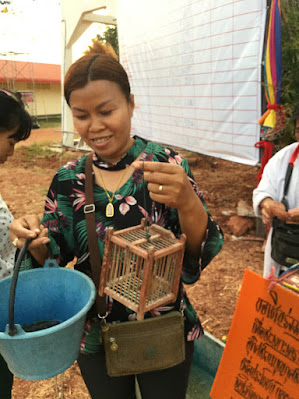
In this Buddhist kingdom, you will often find a bird lady just outside the gate when you go to a large wat, or temple. Bird ladies sell freedom. They sell birds in tiny cages – cages scarcely larger than the birds themselves, and certainly not large enough for those trapped creatures to spread their wings. You don't get to keep the birds, however. For 20 baht (about 40 cents), you get to pull a pair of bamboo bars to release two birds into the wild. One bird is 10 baht, but six birds are 50.
Thailand’s bird ladies give a discount for volume. It is Ahsalahabucha Day, a Thai celebration of Buddha’s first sermon to his first five followers. I pay to release two birds, examining them before I set them free. They are scaly-breasted munias – twittering finch-like birds common on fields in flocks. If they reach maturity, their breast-plumage will take on its trademark brown and white scale-like pattern. My birds are fledglings, however; they are not strong, and their survival in the wild will be perilous. I wonder about this transaction. A woman holds for ransom two small creatures, and then they fly free. She now has a small amount of cash. But what does the purchaser have?
A practising Buddhist might gain some merit toward getting off the eternal Mandela of life, suffering and death. What I have gained, I am not sure. I do know, however, that it needs investigation. There is a metaphor here. Let’s follow it. Buddha’s first sermon enunciated the four principles of Buddhism – the Four Noble Truths. All things are a source of suffering, he taught. Because it can never be fully satisfied, desire is the cause of suffering. Freedom from suffering can only be obtained through the cessation of desire. Lastly, moderation between the extremes of sensualism and asceticism – “the middle way” – can eliminate desire and therefore suffering. With these teachings, he set off a chain reaction that transformed much of Asian society.
Twenty-five hundred years later, Asian societies whose kindness and gentility owe much to these ideas are rushing headlong into market economies, thereby beginning a different kind of transformation. They are responding to market economics so effectively that they are beating the creators of capitalism at their own game. As the pennant of capitalism moves across Asia, however, it is being handed to peoples for whom some of its fundamental ideas are culturally absurd. For example, many scholars maintain that capitalism arose out of the oldest known environmental mission statement: ''be fruitful and multiply, and fill the earth and subdue it; and have dominion over the fish of the sea and over the birds of the air and over every living thing that moves upon the earth.''
Control over nature is woven into the fabric of western society as a moral imperative. In the prevailing view in much of Asia, however, mastery over nature can be nothing less than illusion. Moreover, the motor of market economics is the idea that maximum consumption leads to maximum satisfaction. This notion is fundamentally at odds with Buddha’s concept of the middle way. Even so, it is common intellectual currency in the vast cities of Shanghai, Mumbai and Bangkok to describe these years as Asia’s Century.
In this century, goes the thinking, the mainland's nations will continue to bring people out of poverty at record rates. In this century, previously impoverished countries will develop consumer economies to rival those of America, Europe and Japan. The countries of Asia have already become the workshops of the world; in this century, they will advance that position.
Outside my windows are two miles of lush green fields which end abruptly at the foot of a range of jungled mountains – distant foothills of the Himalayas. I live in a provincial outpost in Thailand – an economically insignificant country in the Third World. My home is in the northern periphery of Southeast Asia – a clutch of nations that shelter more than half a billion souls. To the north is China, with its huge population; to the west, India with its equally teeming cities, towns and villages. Together, these mostly prospering countries host more than half the world’s population. Justifiably, they all want to continue to prosper, and their demands upon the planet are rapidly increasing.
In Asia’s Century, countless bicycles are giving way to motorbikes. Water buffalo are still yielding to mechanized farm equipment. Bangkok's legendary traffic jams tell the continent’s story of rocketing automobile demand. The economic growth in this region will lead to resource depletion on an extraordinary scale in Asia’s Century. Suppose, for example, each Asian begins to demand four barrels of oil per year instead of less than two barrels today – a big increase, but per person consumption still dramatically below that of the rich countries. Suppose also that production and consumption elsewhere do not change.
Using those simplistic assumptions, new Asian demand would soon consume almost all the oil the OPEC cartel now delivers to global markets. Inside and outside the Arabian Peninsula, the world’s great basins of conventional oil are in steep decline. Seen against the few thousand years since civilization began, a century is a considerable time. However, it is almost nothing when compared to the epochs since cellular life debuted on primordial seas and oceans.
Life exploded onto the planet during the Cambrian period of geologic time, beginning 540 million years ago. Its organisms were the raw material for the first oil. Now the world’s most widely traded commodity, oil supplies about 95 per cent of all transportation fuels and 40 per cent of the world's commercial energy. Think of the ages since life and oil began to form as if they have been ticking by on the face of a grandfather clock, starting in the earliest moments of the morning.
It was not until early afternoon that dinosaurs evolved and began to roam. They dominated Earth until seven minutes after nine in the evening. While oil has been developing on this imaginary clock for almost 24 hours, the petroleum industry – now the world’s largest business – did not emerge until five hundredths of a second before midnight. Yet on the stroke of twelve, the last of the world’s conventional oil will be gone. That will be the case whether production lasts for another hundred years, or two hundred.
 We are clever apes indeed, but we cannot replace half a billion years’ accumulation of this vital energy. During the few hundredths of a second since we began consuming oil, we have become much wealthier. Indeed, our wealth is now so closely linked to oil consumption, and our lives are so dependent upon it, that Daniel Yergin’s magisterial history of the industry defined contemporary humanity as Hydrocarbon Man. As Hydrocarbon Man becomes wealthier, we eat more fish – mostly from the world ocean that gave rise to life itself.
 Consider the consequences. A recent letter to the respected scientific journal Nature rattled the academic and environmental communities when it described the results of a lengthy study of the world’s commercial fisheries. This dry report concludes that 90 percent of the raw mass of predatory wild fish in the world’s oceans has disappeared in the last half century. They have been fished out.
Even so, radar and satellite finding techniques and other tools are making the industry’s fishing arsenal more effective. Thus, the entrapment of species is intensifying, not diminishing. Will the world’s fishing fleets soon be trawling empty seas? In a widely quoted statement, the two authors – both academic marine biologists – made no secret of their concern. “From giant blue marlin to mighty bluefin tuna, and from tropical groupers to Antarctic cod, industrial fishing has scoured the global ocean,” said one. “There is no blue frontier left….This isn't just about one species. The sustainability of fisheries is being severely compromised worldwide.” Added the other, "These are the megafauna, the big predators of the sea, and the species we most value. Their depletion not only threatens the future of these fish and the fishers that depend on them, it could also bring about a complete reorganization of ocean ecosystems, with unknown global consequences."
Such stories make human societies seem like cancers on the body of the planet – clusters of cells gone wild, gobbling resources at rates that threaten the very systems that make life possible. But the image is flawed: the death of the creature does not spell the death of creation. During the last half billion years, there have been several great extinctions – geologically brief periods in which countless species suddenly died out. But life always went on, and it will.
We need nature, but nature does not need us. The difference between the extinctions of the present era and those of the ancient past is that today’s are being driven by species rather than act of God. For the first time since the paleontological clock began ticking, one species has grown strong enough to threaten much of the planet.
This is the case for humanity as the bird in the bamboo cage. Who is holding that cage? Call her Earth Mother. Call her Gaia. Call her Bird Lady. The cage she holds is one of our making. As far as I can figure, the base price we will have to offer for our freedom is an exit from the treadmill of ever-greater consumption – abandonment of the notion that greater consumption for greater satisfaction is the proper engine of growth.
Such an idea was sustainable during the millennia in which personal consumption was small relative to the richness of the planet’s wealth. This is no longer so, and soon Asia’s rapid growth will force the issue. To be sprung from our cage, we must collectively endorse the notion of wise consumption in the interest of greater well-being.
What form that will take, I do not know. But as those moments of crisis arrive, I am sure Asia will have the upper hand. If this is Asia’s Century, it is not only because the continent has comparative economic advantages – among others, cheap labour, land and infrastructure – compared to the rich world. It is also because these nations have a living history of modest consumption. They have cultural traditions that make it relatively simple for large numbers of people to quickly shift back into a subsistence economy: such behaviour saved Thailand after the currency crisis of 1997, for example. In addition, many Asians hold deep-rooted beliefs sanctifying moderate consumption in the interest of a life of greater depth and substance. The fourth noble truth is one such idea.
By contrast, in the rich world there is little sense of the large gap of irrelevance between consumption and happiness, despite a wealth of academic findings about the relationship between the two. Psychology says happiness does not appear to depend significantly on external circumstances such as wealth, which many economists define as the ability to consume. In the world’s most consumptive nations, happiness levels today are no greater than they were fifty years ago. Indeed, in some cases the contrary may well be the case.
Westerners have consumed greatly, but not wisely. My children still live in Canada, a resource-rich country whose small numbers have lived abundantly off Earth’s wealth for centuries. I worry because they will inherit a world from which so much of nature’s bounty has been drained. Because Canada and the other rich countries have lived so well for so long, their children have no collective memory of times or traditions in which greater consumption was not society’s primary economic goal, and may have great trouble adapting to a globe without many of the riches which always before have been so easy to exploit. Will they fledge into a natural world so impoverished that even the option of small cage versus perils of freedom is unavailable?
August 2003


Thursday, October 20, 2011

Basic Buddhist Vegetables: A Dhamma Diet

Buddha as part of a Southeast Asian temple
The founder of the HartCenter for Human Actualization offers personal insights into the practice of Buddhism
By Alan Lopez
In my student days there was a dish I would prepare for my housemates. Caught short for time I would fall back on a preparation called Basic Buddhist Vegetables. At the time the title meant nothing to me. The choice was purely instrumental: quick, simple, healthy, and satisfactory to the vegetarian faction. Yet unwittingly I was serving up a dhamma dish. The distinguishing mark of the Buddha’s teaching is taking the basic ingredients of our life as the path.

Religions (and other philosophies) sacrifice the actual for the Truth. Religions claim to teach the Truth, the Ultimate Truth. This is what up lifts the believer, is the obsession of the scholar, and the message of the preacher. What is lost in our praise, devotion, and longing for this Final Truth is the actual. That is, what is actually going on in our body/mind and the circumstances of life as we immediately encounter it. This is what I’m calling Basic Buddhist Vegetables—no special sauce added.

The Buddha had attitudea different attitude.
Without needing to deny, his teaching was not Shiva-centered, Yahweh-centered, or Allah-centered. It was human-centered. But even more so it was centered on what the Buddha called our proper range or field, what I’m calling the actual. He tells a story of a bird that flies out of his range and has an unfortunate encounter with a hawk. Stay within your appropriate field of investigation and action—the available sensory based experience in the here and now. If we begin to take speculative flights, we may, like the bird, meet an unkind fate.

In contrast to other approaches, the Buddha was putting aside the Truth for a journey into the actual. The meditation the Buddha hit upon, vipassana or insight meditation, is precisely this venture into the actual of moment by moment experience. The cardinal characteristics of the actual came to be called the Three Marks of Existence, unsatisfactoriness, impermanence, and no-self. This trinity constitutes the facts of life from which we can run but cannot hide. It is the basic Buddhist fare.

The actual implies engagement. The marks of existence as well as other basic teachings, such as The Four Noble Truths, are not simply street signs describing the neighborhood, but are more like directional arrows pointing the way. Each of the Four Noble Truths has a kiccanana, an accompanying responsibility. The unsatisfactoriness or dis-ease of life demands that we know it—nothing more or less—while the eightfold path, the road to freedom, asks us to walk it. The Buddhist facts of life are not to be taken as a doctrinal model separate from us but as part of our person, our consciousness, and our response-ability.

A practice of the actual grounds us in a simple sanity that imparts a quiet integrity. We are present and aligned because we are attending to the everyday content of experience while keeping grand theories, dogmas, and speculation as a mere side dish. What emerges as a primary interest is how we can relate to the actual and how it works. Our guiding interest is focused on what a contemporary psychotherapist called the “now/how”. What is occurring right now and how does it occur? The Buddha expressed this commitment in his simile of the forest leaves. Scooping up a handful of leaves, he asks his cousin Ananda, are there more leaves on the forest floor or in my hand? He explains the obvious answer by saying, “What I know is like the leaves on the forest floor, but what I teach is like the leaves in my hand.” He teaches what aids our liberation. He doesn’t feed our cognitive appetites.

The confidence that working with the actual is enough relieves us of the burden of spiritual ideals and big Truths. While openness to new possibilities is helpful, the pursuit of ideals leads to vexation. The actual is sacrificed to the ideal. Suzuki Roshi, the founder of San Francisco Zen Center, cautioned his students against being “too idealistic”. Frustration, discouragement, and despair are the shadow-symptoms cast by the ideal.

This contrasts with the solid optimism that grows from an aware acceptance of the actual. We become friendly with what and who we are by embracing ourselves (and the world), not as we fervently believe or wish ourselves to be, but as the very texture of this moment, the actual. Yet facing the facts of life with all their warts and freckles is not a one shot catharsis; it is a daily practice of getting used to “what is”. We eat our Buddhist vegetables one mouthful at a time.

A daily practice to stay connected to the facts of life is to recite the following chant:

The Five Remembrances
I am of the nature to grow old. There is no way to escape growing old.
I am of the nature to have ill health. There is no way to escape having ill health.
I am of the nature to die. There is no way to escape death.
All that is dear to me and everyone I love are of the nature of change; there is no way to escape being separated from them.
My deeds are my closest companions. I am the beneficiary of my deeds. My deeds are the ground on which I stand.
The practice brings us back to our existential condition. The speed of the recitation can be of our choosing. If there is a particular refrain that hits us we can pause to more deeply access its relevance. Resistance to the practice signals our avoidance of “what is”. The chant jolts us out of our frantic busyness or sobers us up from our latest infatuations. The Five Remembrances support an authentic awareness that reminds us, “This is it.”

Whether we consider ourselves Buddhist or not, we need a balanced diet that includes basic veggies, a life staple. While not as filling as meat and potatoes or as alluring glazed desserts, with each serving we are absorbing what is organic to our life, learning to appreciate its flavors by coming into an awesome alignment with the actual. We are finally able to set aside our ideals and beautiful truths and begin to work with what is actually on our plate.
Alan Lopez, Ph.D., maintained a private psychotherapy practice in the Hartford CT area for more than twenty years. He trained mental health professionals in Body Centered Gestalt Therapy in both the USA and Germany. Alan has a lifelong involvement with Eastern spiritual disciplines and presently resides in Asia where he teaches Buddhism. He also offers counseling via internet/video and workshops on his visits to the USA.
Website

Monday, April 02, 2007

The Tragedy of Cambodia

The last century has been uniquely unkind to Cambodia, whose recent history has little of redeeming value. It began with French conquest, and the French were among Europe’s worst colonial masters. Then came partial conquest by Thailand and Japanese occupation during world war two. Fifteen years of corrupt rulers followed.

Then the country found itself caught up in the Indochinese War, with military rulers. When the US lost the war, Pol Pot and the murderous, genocidal Khmer Rouge took over. Apart from the killing and death, their policies destroyed the very foundations of civil society. They emptied the cities; they killed or forced into exile their educated citizenry, burned books and stopped formal education; they banned religion; they weakened the family; in total, they killed a fifth of the population. They ruled by terror.

Then, thankfully, the Vietnamese invaded and occupied the country. Since their departure (brokered by the UN and international diplomacy), the country has remained an economic basket case governed by another string of uneducated and uninspired men. The present leader, Hun Sen, was a bigwig with the Khmer Rouge before (to his credit) shifting allegiances and helping organize the Vietnamese conquest. The recent coronation of a western-educated king may be a ray of hope, however faint.

So it is to the ancient past, not the present, that you need to look for inspiration in Cambodia. Siem Reap is fantastic. This is the part of the country that hosts Angkor Wat and dozens of other huge and magnificent temples. Most were Hindu, but many were Buddhist. Constructed in the jungle, they were later reclaimed by the jungle, too. Angkor is unquestionably one of the wonders of the world. I began reading about Angkor Wat as a boy, and have read much about it since, but I was still quite amazed. Each of the many temples we saw was a marvel in its own right, but Angkor is unquestionably one of the wonders of the world.

We began our adventure by flying to Bangkok, then caught a bus to a Thai border town. We crossed into this tragic country at Poiphet, and there we rented a car. The Lonely Planet describes Cambodian roads as the worst in Asia and among the worst in the world. This is no exaggeration. It took us six hours to make about 150 kilometres in a Toyota Camry.

We eventually arrived in Siem Reap, in the region that hosts Angkor Wat and dozens of other huge and magnificent temples. Most are Hindu, some are Buddhist. They were constructed in the jungle, and later reclaimed by the jungle, too.

Archaeological studies of Angkor Wat have suggested some remarkable things. For example, it is the only temple in the area that you enter from the west – by tradition, the direction of death. Why? After more than a century of debate, in 1977 archaeologist Eleanor Mannika may have cracked the code. Using a traditional Khmer unit of measure, she calculated that the distances to key places in the temple correlated precisely with the years in the Hindu notion of the four ages of time, the yugas of the universe.

As historian David Chandler explains, these distances may be, in effect, “a kind of pun that can be read in terms of time and space….(Walking into the temple) from the west, which is the direction of death, the visitor moves backward into time, approaching the moment when the Indians proposed that time began.” By this interpretation, the central tower, which once housed a now-vanished a statue of Shiva, represented the beginning of time - the golden age of the Krita Yuga. As you depart this sanctum and leave the temple, you are walking toward the Kali Yuga - the present era - at the end of which the universe will be destroyed.

From Siem Reap we took the "ferry" (a wooden boat equipped with a diesel engine from a pick-up truck) to Battambang, Cambodia's second city. The trip along the Tonle Sap ("Great Lake") and up the river was fascinating. It took about six hours - one more than it should have - because the boat's steering system gave up on us half way. The very inventive crew made a fix that took us to our destination, however, and the view of both bird and village life along the way was quite amazing.

We thought we were pretty inured to the sight of poverty after Thailand, but we were shocked by what we saw in Cambodia. The country’s many recent tragedies have set the people’s living standards back to those of the 1920s.

Cambodians are trying to put their past behind them and look to the future, yet their children know little and are not being told about the atrocities committed in their country. The country is taking no serious effort to bring those responsible to book. In our view, the country is crying out for a process of truth and reconciliation. On a positive note, in one village we saw quite a fine school, and there is a medical ferry that delivers care to the people who live in villages along the river.

Except for the temples and the ferry trip, my most vivid memory is a visit to a food stall in the town of Sisiphon. The most prominent offerings included a grilled snake; skewered, roasted bats; and a variety of similarly prepared creepy-crawly cuisine. Various insects, land crabs, small skewered frogs and toads and other ghastly things were among the specials of the day. We bought bottled water and moved on.

Battambang is a desperately poor city filled with wonderful people. Few spoke English, but we found our Thai quite helpful. (Thai and Cambodian are quite different languages, but we could usually find someone who spoke Thai - just as you might fairly easily find someone who speaks Russian in Slovakia.).

We ended our trip by hiring a driver to take us back to Poiphet, thence home to Thailand. By this route the roads were much better, and the 85-kilometre trip only took three hours. Our driver had effective English, and during the trip told us quite vividly how the Khmer Rouge killed almost everyone in his family. Only a sister survived, and the two of them didn't reconnect (through UN efforts) until 15 years later. His commentary was riveting, and emotional. As he talked, I looked out the car window at the throngs in the villages and noticed how few old people (even our age) were there.

Most Cambodians who would have been my contemporaries are gone. Did they die during the Khmer Rouge madness, or from the effects of poverty in the years since? Both, I think.
Enhanced by Zemanta

Friday, March 30, 2007

A Visit to Luang Prabang


“On 25, July, 1861 I came to Luang Prabang,” wrote French explorer Henri Mouhot. It is “a delightful little town, set in its amphitheatre of mountains… a paradise.” It is a good thing he liked it, because Mouhot died there soon after.

Fourteen decades later an American explorer, Edward Gargan, found that the town had retained its charm. “Dawn trickled into Luang Prabang in cobalt blues and mauves flecked with gold and coddled in a cocoon of mist. Before six o’clock, thuds of drums echoed in the distance, and from my balcony I watched silent processions of saffron-swaddled monks, wooden bowls cradled in their palms, pad toward the town center on their morning alms rounds….”

Luang Prabang, the ancient royal capitol of Laos, is situated on a peninsula at the confluence of the Mekong and Nam Khan rivers. It is astonishingly beautiful, and rather otherworldly.

Phu si, a ‘sacred mountain’ three hundred meters high, dominates the town. Shrouded in palm trees, bougainvillea and a riot of other tropical flowers, it is adorned with Buddhist shrines and surmounted by a wat (temple) with commanding views of the surrounding hills and rivers. Down below, next to the broad and muddy Mekong, is the former Royal Palace, set amid venerable, teak-built wats of jewel-like perfection, intricately painted in red and gold. The famous "floating roofs" of these buildings give the illusion of hovering - almost as though they do not touch the temple walls.

The City.... Luang Prabang has been designated a world heritage site by UNESCO. It is reputed to be the best-preserved city in South East Asia. There is an overwhelming sense here of anachronism; of a place out of time, in which seventeenth century wats easily and gracefully commingle with French colonial architecture.

The present impinges, of course, in certain things. I began writing this from an Internet cafe, a twenty-first century phenomenon. However, the two adjoining computer stations were occupied by orange robed Buddhist monks with shaven heads, identical in every respect to their sangha predecessors of the far distant past.

UNESCO has been responsible for a simple and quite clever improvement to this city. Since my last visit, many of the sidewalks and gutters have been replaced with brick pavements. In the rest of South East Asia, the pedestrian is condemned to walk along the roads, which is dangerous because of traffic. In Luang Prabang one can stroll along the riverbanks on wide brick walkways, enjoying diverse and beautiful prospects, and let the mind wander. On a crisp, cool January morning, this place is a walker’s paradise.

Unlike other cities in Southeast Asia, traffic has not taken over. Laos is one of the poorest countries on the planet, and while Luang Prabang is a prosperous enclave, affluence here runs to motorcycles, not SUVs. The humble bicycle is still commonplace in Luang Prabang.

....And its Story: Laos was a bit player in the ‘American War’, as it is called here – the Vietnam War, as it is known in the west. The country received its (massive) quota of B52 bombing runs, but mostly in the east of the country in the Plain of Jars and along the Ho Chi Minh trail. Few people know how relentlessly American bombers pounded Laos during the American War. In sheer tonnage, the explosive power of bombs dropped on Laos (2.092,900 tons) was greater than that of all the bombs the Americans hurled at Europe and Japan during world war two.

Luang Prabang was spared. Now and then, however, you may see a piece of old US ordinance – a bomb or an artillery shell – used as a planter or set out as decoration. This is almost like smiling at the horrors of the war. What other people could be so forgiving?

Following the American defeat, and inspired by the mindless fanaticism of China's Cultural Revolution (which was then just ending) the new Pathet Lao (communist) government made an effort to ban Buddhism. Their efforts failed utterly.

In the morning you can watch the monks, eyes lowered, on their alms rounds. Now and again one will see an alms giving beneath a red flag with the yellow hammer and sickle, the banner of the Lao communist party. It is as though the Laos have managed a harmonious fusion of Gotama’s ‘middle way’ with the classless society of the communist international. The net result is a sufficiency of things (just), and a remarkable degree of contentment. Despite the incompetence of one of the world's most secretive governments, everyone seems to have enough, and people appear to be happy.

The former Royal Palace has been converted into the National Museum. It contains the regalia of the Lao monarchy, and also, Buddha statues -- by the hundreds. Case after case displays Buddhas in gold, in silver, in rock crystal and bronze, some ancient, and many exquisite as works of art.

In a curious way the Laos calculate their national net worth in Buddhas. It is okay to export antiques from Laos, with the single exception of antique Buddhas. And one of the standard day trips out of Luang Prabang is the two-hour boat trip along the Mekong to the Pak Ou caves, in which for 500 years or more old or worn household Buddhas have been deposited. Now they stand in serried ranks by the thousands, gazing silently out at those who come to look and to wonder.

In the west we store our wealth in vaults (as at Fort Knox) to back our currencies; in Laos they store their wealth of Buddhas in natural caves to conserve the nation’s ‘good karma’.

An interesting exhibit at the National Museum is displayed in a case full of gifts from the United States to the Lao monarchy. It is a Lyndon Bains Johnson Presidential silver medal, presented to King Savang Vatthana in 1965 or so. It was Richard Nixon, four or five years later, who began the US bombing campaign against the ‘Viet Cong’ in Laos and Cambodia. With the triumph of the Pathet Lao in 1975, the king abdicated his throne, and that was the end of the monarchy. The new government later secretly (and savagely) executed the royal family.

Many French nationals visit Luang Prabang -- more, perhaps than from any other western country. This small city on the Mekong has enjoyed a special place in the French psyche ever since the glory days of French Indochina. Luang Prabang was a place for French colonial officials short on drive and ambition to secure a government posting and then disappear, often marrying Laos and ‘going native’. I think Luang Prabang conjures visions for the French that are comparable to their images of Gauguin’s Tahiti.

Lingua Franca:
Sadly for the French visiting now, they have to place their restaurant orders in English. Even in this storied outpost of French Indochina, few Laotians speak French. A Lao taxi driver I met, fluent in both English and French, was snickering over an exchange he had with some French passengers. While speaking with them he pretended to understand only English. And he understood perfectly when they expressed their outrage in French over his unbecoming and historically bizarre ignorance of la belle langue.

Unlike in neighbouring countries, there is no sex tourism in Laos. I understand that this kind of ‘fraternisation’ is illegal here, and certainly no one has offered me a woman (or child). A waiter practicing his English yesterday expressed his pride that Lao women are becomingly modest, wearing, for example, decently long skirts. But then, officially communist countries do tend to exhibit a puritan streak.

To see in practice the active steps taken by the Lao Government to combat sex tourism, one need look no further than the back of the door of any guesthouse room, where a midnight curfew is prominently posted on a highly official, stamped and sealed document. This directive is posted on government authority. It includes other regulations promoting austerity. Some are directed at discouraging sex tourism; others at prohibiting other forms of immoral behaviour. Examples:

• “Disallow to apply another dopes and betting in the guest house.”

• “Awesome received or lead the guests in to your room before you get allowed from the staff.”

• “If ay one to perform this regulation will get pendalty to put on trial by the law.”

Imagine being a French visitor to this outpost of France’s glorious past, and, by way of having insult added to injury, having to decipher such English as this!

Thursday, September 21, 2006

Living and Teaching in Thailand

By Peter McKenzie-Brown

This week it was a coup d'état. What next?!!!

My wife Bernie and I moved to Thailand from Canada several years ago just for the adventure. Well, adventure it has been, and we have enjoyed almost all of it! It’s a beautiful country, and we love living here.

We have observed the extraordinary economic development of the cities, and the growth of the middle class. However, we have also watched predations by government on the lives of Thai people. (We hope the peaceful coup will bring that to an end, but we have our doubts.) We have witnessed the desperate poverty of many people in hills and slums. And delightfully, we have also experienced the great kindness and gentleness of the Thai people.

Underlying all of this was my job as a teacher. I began teaching English, but today I teach visitors to Thailand how to teach English as a foreign language (TEFL). My work has brought stability into our lives, and it has brought us in touch with the Thai people. In Thai society, teachers are held in high esteem, and Thai students are a pleasure to have in class.

In this commentary I want to talk about living and teaching here, but also to offer a perspective on the country’s culture and politics. If the latter isn’t your thing, you can always stop reading!

Working in Thailand. I enjoyed a long corporate career before coming here. However, to get a job and a work permit in Thailand, before leaving Canada I took a one-year fulltime university program to get certification as a teacher of English as a second or other language (CERTESOL). That was a lot more than I needed, but it made it quite easy for me to get a job at Chiang Mai University (CMU) when I arrived. A year ago, I moved from the English Department to CMU’s Language Institute.

If you want to work in Thailand, TEFL accreditation is now required. You can get this from a number of places, although I personally think the TEFL course my colleague Karla M. Portch and I have developed is first rate. You will find many references to it on this blog.

Effective October 1 of this year, Thailand is putting severe restrictions on the right of foreigners to stay here indefinitely on tourist visas. As a result, becoming a long-term resident is now much more problematic. So, the other thing you need when you come here is a non-tourist visa – preferably a B (business) visa. If you can arrange that, it will be much easier to get a work permit.

If you have a TEFL certificate, you will be able to find work. Jobs are usually available at language schools, but they do not pay particularly well as long as you are a part-time teacher. Even small pay checks go a long way in this country, however, unless you want to enjoy a Western lifestyle.

As you gain experience, full-time opportunities can open up at language schools. They are also available in the public and private school systems, especially beginning at the end of May when the academic year begins. Chiang Mai alone is home to five universities, and many technical schools besides.

Also, many of our TEFL graduates find themselves teaching individuals or small groups of private clients. Most Thai people know the advantages of having English language skills, particularly because this country relies so heavily on the tourist trade. The demand for better English is great.

Living Here. Now settled, our lives seem normal. We think of Chiang Mai as just the place we live. Oddly, the ways we spend our days sometimes do not seem terribly different from when we lived in Canada -- different landscape, different language, different climate, different food and, yes, definitely a different pace of life! We have the occasional twinge of yearning for things more familiar, but that generally passes quickly.

Since we arrived here, we have witnessed all of life's rites of passage among our friends: marriage and divorce, birth and death. When a friend died a painful and lingering death from cancer a few months ago, it oddly created for us a special closeness to this city.

We are nearing the end of the rainy season, and we have had quite a bit of the wet stuff this year. In this part of Thailand the rains generally come for brief periods (often at night, when we are asleep), and are not at all disturbing. The rains are warm, and they keep the air clean and the vegetation lush and green. However, we don't travel a great deal during these months. But the dry, cool season begins in October. That's a great time for road trips.

A Recent Diary. A few weeks ago, Bernie and I went to a refugee camp at the Myanmar (Burma) border as part of my Rotary work. It was extraordinary to see again how different the two countries are. At one point we went to a temple whose landholdings were now, by international agreement, half on the Myanmar side of the border.

Once the border dispute was settled, the Myanmar authorities destroyed the village on their side and forced the Shan villagers to flee to Thailand. The army took over the concrete temple buildings and filled them with soldiers. The border now bristles with these people, who have also laid land mines just inside the border.

It's hard to believe the cruelty of the Burmese government to its ethnic (for example, Shan) minorities. This kind of thing is routine. On the positive side, a sort of "normal" life has been created in the refugee camp compliments of the Buddhist temple and an NGO.

The refugees now live in single-family bamboo huts. The kids receive a basic education at the temple, many of the women receive vocational training like dressmaking and crafts, and the men and some of the younger women go off to the fields to pick chillies or whatever else happens to be in season, for 10 baht (25 cents) per kilo. These people do not have Thai citizenship, so their movements are at the discretion of the Thai officials.

Who knows what the future holds for them? Well, at least for now they don't have to live in fear.

East Asian and Western World Views. While Thailand now has much of the feeling of home, the cultural differences are many, with Thais seeing the world quite differently from the way we view it in the West. Here are our quick summary and general observations: Westerners see things as rather black and white, while East Asians see them as heavily nuanced by relationships. Beliefs in the equality of man and in human rights are very real in the West. In East Asia, patron-client relationships are more important. And the immediate family is an incredibly powerful social unit.

In Thailand, one of the most extraordinary institutions is that of the monarchy. His Majesty King Bhumipol has been on the throne for 60 years, and the celebrations here have been great. It is quite hard for westerners to appreciate the reverence Thais have for their king. He's seen as simultaneously the embodiment of the Hindu god Vishnu (the preserver) and the incarnation of the Buddhist ideal of a king inspired by Dhamma (cosmic law). Thais believe without question that he can guide his people toward greater goodness, and his support of the recent coup was essential for it to succeed.

It is impossible to imagine how this country will ultimately respond to his death. Long may he reign!

The Coup. Like other westerners steeped in the traditions of democracy, I believe coups d'état are terrible. However, until the recent one occurred, the political situation here was an incredible mess. The country was running smoothly because of its efficient civil service. However, Thailand had not had a functioning government since February. That's when the prime minister and his cronies finally reached a level of corruption even Thailand couldn't handle. Although popular in rural Thailand, Thaksin Shinawatra was mostly despised by the middle class, intellectuals and the country’s elite.

There were weeks of mass protests and a rigged snap election that the opposition parties boycotted. The king called for the courts to settle the political controversy, and the results say a lot about the state of corruption at that time. The courts overturned the election and demanded a new one. The key members of the country's Election Commission were thrown in jail for their part in the travesty. It is unfortunate that the country did not have the political maturity to continue to rely on the courts to solve its problems. But perhaps the coup was the only viable solution. Who knows?

Final comment. There is still a great deal of blood being spilled in this country, but it is mostly limited to the three (Muslim) southernmost provinces. A tragic, shadowy insurgency began there nearly three years ago, and the previous government mishandled it from the start. People were being killed by both the terrorism of the insurgents and nastiness of the government, who waltzed over western concepts of human rights.

The recent coup offers some encouragement. The general in charge of the coup is a Muslim (such a thing has never happened before in this Buddhist country!) and he is known to be conciliatory. Perhaps the mess in Thailand’s Deep South can finally be resolved.

To my mind one of the biggest mysteries of this affair is how completely Thais seem to have accepted it. An extremely popular leader (at least, in rural areas) has been overthrown, yet the people have said nothing. Those I have spoken to seem to believe democracy is alive and well. Another common theme is that the king is safe and healthy, so why worry? Perhaps this just reflects how Thais view the world: after all, Buddhism teaches us to accept whatever happens.

Or perhaps they are afraid to express what they feel. The soldiers are serious about having taken power, and they will brook no interference.
Enhanced by Zemanta