Showing posts with label Thai people. Show all posts

Saturday, May 23, 2009

Canadian gifts help mobilize the disabled


Crippled when she fell from a building 15 years ago, Ratchapon Deesala receives a gel cushion and a much-needed replacement wheelchair. Ratchapon lives with family in the community.
By Bernie McKenzie-Brown

For most of us, it is a simple matter to get out of bed and get ready to take on the day. Spare a thought, though, for those who can’t get out of bed because they are quadriplegic. Spare another for those who can’t get out because they need help dressing and getting into their wheelchairs. Then there are the men and women who need colostomy bags changed or urinary catheters replaced before their days can begin. This is reality for many disabled adults. For a fortunate few, life has begun to improve.

Last week physically handicapped patients and staff at McKean Hospital couldn’t hide their excitement and pure joy as medical equipment and other items started to arrive. The day’s delivery included two modified beds – one for a quadriplegic and one for a paraplegic – as well as a dozen new wheelchairs and 15 gel cushions.

This Canadian-funded initiative is helping transform life for young and severely disabled adults who live at Chiang Mai’s McKean Rehabilitation Centre. The 720,000-baht project has begun to provide help for 13 extended-stay rehabilitation patients and for outpatient clients who live in their community. Their ages range from about 16 to 42. Some have suffered since birth; others are often victims of motorcycle and industrial accidents.

Those who live at McKean share accommodation in tiny one-bedroom bungalows. All suffer from debilitating handicaps. They desperately need equipment and such aides for daily living as wheelchairs, braces, and prosthetics to make their lives more comfortable. Unfortunately, this equipment is too expensive for their families to afford. The hospital delivers good care in a caring environment, but it, too, is constrained by budgets.

An initiative of the Rotary Club of Chiang Mai West, the McKean Disabled Project’s main aim is to make it easier for the disabled to move about. In addition to purchasing high-quality wheelchairs, the Canadian project has provided funds for the purchase of motorcycles, which will be modified for use by wheelchair-bound patients. The project has also modified regular bicycles into tricycles propelled by hand.

The project has other aims, one of which is to help patients deal with painful bed sores. This terrible condition develops in those confined to beds or even wheelchairs. To manage this condition, the project has funded the purchase of gel cushions.


McKean’s residents show off new equipment and supplies, from hand-driven bicycles to gel cushions.


Funding began with a grant from the Rotary Club of Calgary Centennial. Several Canadians also made personal cash gifts. These sums were then matched by The Wild Rose Foundation, a funding agency sponsored by the government of Alberta (a Canadian province). This agency, which promotes charitable, philanthropic, humanitarian, and public spirited acts, thus provided the single largest contribution to the project. These sums were topped up by The Rotary Foundation, taking total contributions to the budgeted amount of 720,000 baht. The involvement of several branches of the global Rotary organization is tribute to the far-reaching philanthropy of the world’s largest service organization.

McKean Hospital has been serving the people of Northern Thailand for a century. It was established by a humanitarian missionary surgeon, James McKean, in response to the plight of those with leprosy in Chiang Mai. Still the centre for leprosy treatment in northern Thailand, today McKean also operates a program of extended general rehabilitation programs to treat the disabled. McKean Hospital’s disabled patients include those who live at the facility full-time; those receiving short-term treatment; and outpatients.

For some people, the simple act of getting out of bed in the morning is no simple matter. For some who live with this simple truth, simple generosity is bringing hope and the gift of greater mobility.
Enhanced by Zemanta

Sunday, November 05, 2006

A Study in Thai


I recently updated my book, Teach and Learn: Reflections on Communicative Language Teaching, from which this is a chapter, and made it available on Kindle and as an inexpensive paperback. To enjoy a read, please click here.


By Peter McKenzie-Brown
Many of the characteristic errors Thais make in English are directly related to interference from their own language and culture. “Contrastive analysis” is the process of understanding learner errors by comparing the make-up of a second language with the learner’s native tongue. In these notes, we make a start.

Thai society is highly stratified, and differences in social status are reflected in Thai grammar. The royal family has its own set of pronouns and word uses, used exclusively by its members and those who work for them. So does the Buddhist establishment. Thus, there are four major “registers” – subsets of language used in particular social settings – in Thai speech. These are royal, ecclesiastical, polite and vernacular.

Besides being stratified, Thailand has brought together diverse groups of people over a very short period of time, and the country’s borders with it neighbours are porous. As a result, Thai is one of many languages spoken in the country. Others include Khmer, along the border with Cambodia, and a variety of Burmese and tribal languages in the north and along the Thai/Myanmar border.

Thais speak four main dialects. The central dialect, which is the official language of Thailand, is spoken in Bangkok and environs. This dialect is known as klang. The other three major dialects are khammauang, spoken in the north; lao, which is used in the northeast, and tâi, which is the southern dialect.

Grammar: Thai is a flexible language which has no prefixes or suffixes, no genders for nouns, no articles, no plurals and no verb conjugations. It is a high-context language, which means it conveys much information through context rather than through linguistic rules.

On the other hand, it has at least 49 pronouns, including at least 17 for “I” and 19 for “you.” The choice of pronoun indicates the gender of the speaker: for instance, põm means “I” for a male; diichán means “I” for a female. The other pronouns indicate the degree of familiarity you have with the person you are addressing, the nature of the conversation (for example, personal or business), and the level of respect you wish to show. Personal pronouns do not change, regardless of their place within a sentence. There are no possessive pronouns in Thai.

To complicate matters further – from an English speaker’s perspective, – Thais will frequently use nouns (including proper nouns) as pronouns. For example, young girls and sometimes even young women use the Thai word for mouse as the personal pronoun “I.” Women especially, but also men, also sometimes use their personal names instead of the pronoun “I”. When talking to or about foreigners, Thais will occasionally substitute faràng (Thai for “foreigner”) for “you, him, her or them.”

Thai uses particles as polite “closing” words, or to indicate degree of familiarity between the speakers. These one-syllable words are always found at the end of a clause or sentence. Since a single sentence may have several clauses, it may also repeat the same particle several times. The most common particles are khâ (used by women) and khráp (used by men.) These particles literally mean “yes” in polite Thai, and can be used scores of times in a single conversation. Particles suggest courtesy and power relationships. Thais will sometimes explain that sentences without particles are “not beautiful.”

The main Thai dialect has five tones. Thai writing therefore requires four tone markers. These tone markers represent the high tone, the low tone, the falling tone and the rising tone. The mid-tone – also called the common tone – does not require a tone marker.

The word order in a simple Thai sentence is subject-verb-direct object. If there is an indirect object, the word order is subject-verb-direct object-indirect object. Adjectives and adverbs follow the word they modify. Numbers precede the noun.

In Thai sentence structure, you don’t use intransitive verbs when you describe Thai nouns. You say “She beautiful,” or “Computer expensive very.” In Thai, these are complete sentences. They do not require a verb.

Thai suggests plurals with the use of noun classifiers, of which there are many. In effect, Thais say “I have pen, four item” rather than “I have four pens.” Parallel structures exist in English, but they are rare – for example, “50 head of cattle.”

Thai/English Phonology: English has many features that cause difficulties for native-speakers of Thai. This summary reviews pronunciation problems that Thai learners frequently have with English pronunciation.

English has six consonant sounds that do not exist in Thai: /v, th (voiced and unvoiced), z, sh, zh/. Also, the Thai /r/ is quite different from the English retroflex /r/, and Thai speakers frequently pronounce this sound as /l/, even in their own language.

For Thais, many consonant clusters are difficult to pronounce. There are several reasons for this. For one, only two consonants maximum are permitted at the beginnings of words in Thai. In addition, there are no consonant clusters in Thai word endings. Only eight consonants – /n, m, ng, pb, dt, g, y, w/ – are allowed to occur in that position.

While English pronunciation is heavily dependent on consonants, Thai pronunciation is heavily dependent on vowels. Thai has many more vowel sounds than English, and in Thai it is important to pronounce vowels distinctly.

In English, the vowels of unstressed syllables in content words and the vowels of function words are generally reduced or even dropped. English speakers often reduce vowels to schwa (the unstressed sound “uh”); this can make them almost inaudible to the Thai ear.

English function words, which are generally unstressed, are often dramatically reduced. English speech is stress-timed rather than syllable-timed.

The Writing System: Thai uses an alphabet related to that of Sanskrit. Most native-English speakers accustomed to the relative simplicity of the Roman alphabet find it difficult to learn. The system is phonetically quite precise, however. There are few irregular spellings, and to native-Thai speakers the rules of composition are quite natural.

The Thai writing system has 44 consonants that represent only 21 distinct sounds. (Two consonants are obsolete and 12 rarely used. A number of consonants are redundant in the sense that they convey the same sound as other consonants. Part of the reason for this redundancy is that consonants are grouped into three groups – high-tone consonants, middle-tone consonants and low-tone consonants. This approach is used to enable the writer to convey tones.

Each consonant has a character name to help when spelling it out loud. For example, the first consonant in the alphabet is gaw-gài. The first syllable suggests the consonant sound, while the second represents a word (in this case gài or “chicken”) with which to associate the letter.

There are 21 vowels, which are used in various combinations to create 32 different vowel sounds – either long or short vowels. While tone markers are consistently placed above the letters of the alphabet, different vowels are placed in front of, above, behind, under or around the consonants.

The following text illustrates the main features of the Thai writing system. In addition to the placement of vowels and tone markers, note that that written Thai uses no punctuation. There are no capital letters. Full stops, question marks and exclamation marks do not end Thai sentences. Neither does the system use the complex Western arrangement of commas, colons, dashes and other characters used in European punctuation. Also, there are no spaces between words except in the case of Arabic numbers, which writers separate from the Thai text.
ในวันที่ 25 พฤษภาคม 2549 ในหลวงได้รับการถวายรางวัลจากองค์การสหประชาติในความสำเร็จทางด้านการพัฒนาความเป็นอยู่ของมนุษยชาติซึ่งนายโคฟีอันนันเลขาธิการสหประชาชาติได้นำมาถวายด้วยตัวเอง
The text refers to the Human Development Lifetime Achievement Award presented to the King by UN Secretary General Kofi Anan on behalf of the United Nations Development Programme. The award was presented on May 25, 2006 (2549 on the Buddhist calendar).

To Sum up: As this brief discussion illustrates, studying the contrasts between Thai and English can shed light on the errors your Thai students make. Enabling teachers to better understand the linguistic features of another language provides insights into the subtleties of language itself. This should help you become better at the job of teaching English.

Thursday, September 21, 2006

Living and Teaching in Thailand

By Peter McKenzie-Brown

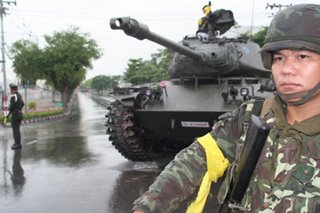
This week it was a coup d'état. What next?!!!

My wife Bernie and I moved to Thailand from Canada several years ago just for the adventure. Well, adventure it has been, and we have enjoyed almost all of it! It’s a beautiful country, and we love living here.

We have observed the extraordinary economic development of the cities, and the growth of the middle class. However, we have also watched predations by government on the lives of Thai people. (We hope the peaceful coup will bring that to an end, but we have our doubts.) We have witnessed the desperate poverty of many people in hills and slums. And delightfully, we have also experienced the great kindness and gentleness of the Thai people.

Underlying all of this was my job as a teacher. I began teaching English, but today I teach visitors to Thailand how to teach English as a foreign language (TEFL). My work has brought stability into our lives, and it has brought us in touch with the Thai people. In Thai society, teachers are held in high esteem, and Thai students are a pleasure to have in class.

In this commentary I want to talk about living and teaching here, but also to offer a perspective on the country’s culture and politics. If the latter isn’t your thing, you can always stop reading!

Working in Thailand. I enjoyed a long corporate career before coming here. However, to get a job and a work permit in Thailand, before leaving Canada I took a one-year fulltime university program to get certification as a teacher of English as a second or other language (CERTESOL). That was a lot more than I needed, but it made it quite easy for me to get a job at Chiang Mai University (CMU) when I arrived. A year ago, I moved from the English Department to CMU’s Language Institute.

If you want to work in Thailand, TEFL accreditation is now required. You can get this from a number of places, although I personally think the TEFL course my colleague Karla M. Portch and I have developed is first rate. You will find many references to it on this blog.

Effective October 1 of this year, Thailand is putting severe restrictions on the right of foreigners to stay here indefinitely on tourist visas. As a result, becoming a long-term resident is now much more problematic. So, the other thing you need when you come here is a non-tourist visa – preferably a B (business) visa. If you can arrange that, it will be much easier to get a work permit.

If you have a TEFL certificate, you will be able to find work. Jobs are usually available at language schools, but they do not pay particularly well as long as you are a part-time teacher. Even small pay checks go a long way in this country, however, unless you want to enjoy a Western lifestyle.

As you gain experience, full-time opportunities can open up at language schools. They are also available in the public and private school systems, especially beginning at the end of May when the academic year begins. Chiang Mai alone is home to five universities, and many technical schools besides.

Also, many of our TEFL graduates find themselves teaching individuals or small groups of private clients. Most Thai people know the advantages of having English language skills, particularly because this country relies so heavily on the tourist trade. The demand for better English is great.

Living Here. Now settled, our lives seem normal. We think of Chiang Mai as just the place we live. Oddly, the ways we spend our days sometimes do not seem terribly different from when we lived in Canada -- different landscape, different language, different climate, different food and, yes, definitely a different pace of life! We have the occasional twinge of yearning for things more familiar, but that generally passes quickly.

Since we arrived here, we have witnessed all of life's rites of passage among our friends: marriage and divorce, birth and death. When a friend died a painful and lingering death from cancer a few months ago, it oddly created for us a special closeness to this city.

We are nearing the end of the rainy season, and we have had quite a bit of the wet stuff this year. In this part of Thailand the rains generally come for brief periods (often at night, when we are asleep), and are not at all disturbing. The rains are warm, and they keep the air clean and the vegetation lush and green. However, we don't travel a great deal during these months. But the dry, cool season begins in October. That's a great time for road trips.

A Recent Diary. A few weeks ago, Bernie and I went to a refugee camp at the Myanmar (Burma) border as part of my Rotary work. It was extraordinary to see again how different the two countries are. At one point we went to a temple whose landholdings were now, by international agreement, half on the Myanmar side of the border.

Once the border dispute was settled, the Myanmar authorities destroyed the village on their side and forced the Shan villagers to flee to Thailand. The army took over the concrete temple buildings and filled them with soldiers. The border now bristles with these people, who have also laid land mines just inside the border.

It's hard to believe the cruelty of the Burmese government to its ethnic (for example, Shan) minorities. This kind of thing is routine. On the positive side, a sort of "normal" life has been created in the refugee camp compliments of the Buddhist temple and an NGO.

The refugees now live in single-family bamboo huts. The kids receive a basic education at the temple, many of the women receive vocational training like dressmaking and crafts, and the men and some of the younger women go off to the fields to pick chillies or whatever else happens to be in season, for 10 baht (25 cents) per kilo. These people do not have Thai citizenship, so their movements are at the discretion of the Thai officials.

Who knows what the future holds for them? Well, at least for now they don't have to live in fear.

East Asian and Western World Views. While Thailand now has much of the feeling of home, the cultural differences are many, with Thais seeing the world quite differently from the way we view it in the West. Here are our quick summary and general observations: Westerners see things as rather black and white, while East Asians see them as heavily nuanced by relationships. Beliefs in the equality of man and in human rights are very real in the West. In East Asia, patron-client relationships are more important. And the immediate family is an incredibly powerful social unit.

In Thailand, one of the most extraordinary institutions is that of the monarchy. His Majesty King Bhumipol has been on the throne for 60 years, and the celebrations here have been great. It is quite hard for westerners to appreciate the reverence Thais have for their king. He's seen as simultaneously the embodiment of the Hindu god Vishnu (the preserver) and the incarnation of the Buddhist ideal of a king inspired by Dhamma (cosmic law). Thais believe without question that he can guide his people toward greater goodness, and his support of the recent coup was essential for it to succeed.

It is impossible to imagine how this country will ultimately respond to his death. Long may he reign!

The Coup. Like other westerners steeped in the traditions of democracy, I believe coups d'état are terrible. However, until the recent one occurred, the political situation here was an incredible mess. The country was running smoothly because of its efficient civil service. However, Thailand had not had a functioning government since February. That's when the prime minister and his cronies finally reached a level of corruption even Thailand couldn't handle. Although popular in rural Thailand, Thaksin Shinawatra was mostly despised by the middle class, intellectuals and the country’s elite.

There were weeks of mass protests and a rigged snap election that the opposition parties boycotted. The king called for the courts to settle the political controversy, and the results say a lot about the state of corruption at that time. The courts overturned the election and demanded a new one. The key members of the country's Election Commission were thrown in jail for their part in the travesty. It is unfortunate that the country did not have the political maturity to continue to rely on the courts to solve its problems. But perhaps the coup was the only viable solution. Who knows?

Final comment. There is still a great deal of blood being spilled in this country, but it is mostly limited to the three (Muslim) southernmost provinces. A tragic, shadowy insurgency began there nearly three years ago, and the previous government mishandled it from the start. People were being killed by both the terrorism of the insurgents and nastiness of the government, who waltzed over western concepts of human rights.

The recent coup offers some encouragement. The general in charge of the coup is a Muslim (such a thing has never happened before in this Buddhist country!) and he is known to be conciliatory. Perhaps the mess in Thailand’s Deep South can finally be resolved.

To my mind one of the biggest mysteries of this affair is how completely Thais seem to have accepted it. An extremely popular leader (at least, in rural areas) has been overthrown, yet the people have said nothing. Those I have spoken to seem to believe democracy is alive and well. Another common theme is that the king is safe and healthy, so why worry? Perhaps this just reflects how Thais view the world: after all, Buddhism teaches us to accept whatever happens.

Or perhaps they are afraid to express what they feel. The soldiers are serious about having taken power, and they will brook no interference.
Enhanced by Zemanta