Showing posts with label fluency. Show all posts

Sunday, November 05, 2006

A Study in Thai


I recently updated my book, Teach and Learn: Reflections on Communicative Language Teaching, from which this is a chapter, and made it available on Kindle and as an inexpensive paperback. To enjoy a read, please click here.


By Peter McKenzie-Brown

Many of the characteristic errors Thais make in English are directly related to interference from their own language and culture. “Contrastive analysis” is the process of understanding learner errors by comparing the make-up of a second language with the learner’s native tongue. In these notes, we make a start.

Thai society is highly stratified, and differences in social status are reflected in Thai grammar. The royal family has its own set of pronouns and word uses, used exclusively by its members and those who work for them. So does the Buddhist establishment. Thus, there are four major “registers” – subsets of language used in particular social settings – in Thai speech. These are royal, ecclesiastical, polite and vernacular.

Besides being stratified, Thailand has brought together diverse groups of people over a very short period of time, and the country’s borders with it neighbours are porous. As a result, Thai is one of many languages spoken in the country. Others include Khmer, along the border with Cambodia, and a variety of Burmese and tribal languages in the north and along the Thai/Myanmar border.

Thais speak four main dialects. The central dialect, which is the official language of Thailand, is spoken in Bangkok and environs. This dialect is known as klang. The other three major dialects are khammauang, spoken in the north; lao, which is used in the northeast, and tâi, which is the southern dialect.

Grammar: Thai is a flexible language which has no prefixes or suffixes, no genders for nouns, no articles, no plurals and no verb conjugations. It is a high-context language, which means it conveys much information through context rather than through linguistic rules.

On the other hand, it has at least 49 pronouns, including at least 17 for “I” and 19 for “you.” The choice of pronoun indicates the gender of the speaker: for instance, põm means “I” for a male; diichán means “I” for a female. The other pronouns indicate the degree of familiarity you have with the person you are addressing, the nature of the conversation (for example, personal or business), and the level of respect you wish to show. Personal pronouns do not change, regardless of their place within a sentence. There are no possessive pronouns in Thai.

To complicate matters further – from an English speaker’s perspective, – Thais will frequently use nouns (including proper nouns) as pronouns. For example, young girls and sometimes even young women use the Thai word for mouse as the personal pronoun “I.” Women especially, but also men, also sometimes use their personal names instead of the pronoun “I”. When talking to or about foreigners, Thais will occasionally substitute faràng (Thai for “foreigner”) for “you, him, her or them.”

Thai uses particles as polite “closing” words, or to indicate degree of familiarity between the speakers. These one-syllable words are always found at the end of a clause or sentence. Since a single sentence may have several clauses, it may also repeat the same particle several times. The most common particles are khâ (used by women) and khráp (used by men.) These particles literally mean “yes” in polite Thai, and can be used scores of times in a single conversation. Particles suggest courtesy and power relationships. Thais will sometimes explain that sentences without particles are “not beautiful.”

The main Thai dialect has five tones. Thai writing therefore requires four tone markers. These tone markers represent the high tone, the low tone, the falling tone and the rising tone. The mid-tone – also called the common tone – does not require a tone marker.

The word order in a simple Thai sentence is subject-verb-direct object. If there is an indirect object, the word order is subject-verb-direct object-indirect object. Adjectives and adverbs follow the word they modify. Numbers precede the noun.

In Thai sentence structure, you don’t use intransitive verbs when you describe Thai nouns. You say “She beautiful,” or “Computer expensive very.” In Thai, these are complete sentences. They do not require a verb.

Thai suggests plurals with the use of noun classifiers, of which there are many. In effect, Thais say “I have pen, four item” rather than “I have four pens.” Parallel structures exist in English, but they are rare – for example, “50 head of cattle.”

Thai/English Phonology: English has many features that cause difficulties for native-speakers of Thai. This summary reviews pronunciation problems that Thai learners frequently have with English pronunciation.

English has six consonant sounds that do not exist in Thai: /v, th (voiced and unvoiced), z, sh, zh/. Also, the Thai /r/ is quite different from the English retroflex /r/, and Thai speakers frequently pronounce this sound as /l/, even in their own language.

For Thais, many consonant clusters are difficult to pronounce. There are several reasons for this. For one, only two consonants maximum are permitted at the beginnings of words in Thai. In addition, there are no consonant clusters in Thai word endings. Only eight consonants – /n, m, ng, pb, dt, g, y, w/ – are allowed to occur in that position.

While English pronunciation is heavily dependent on consonants, Thai pronunciation is heavily dependent on vowels. Thai has many more vowel sounds than English, and in Thai it is important to pronounce vowels distinctly.

In English, the vowels of unstressed syllables in content words and the vowels of function words are generally reduced or even dropped. English speakers often reduce vowels to schwa (the unstressed sound “uh”); this can make them almost inaudible to the Thai ear.

English function words, which are generally unstressed, are often dramatically reduced. English speech is stress-timed rather than syllable-timed.

The Writing System: Thai uses an alphabet related to that of Sanskrit. Most native-English speakers accustomed to the relative simplicity of the Roman alphabet find it difficult to learn. The system is phonetically quite precise, however. There are few irregular spellings, and to native-Thai speakers the rules of composition are quite natural.

The Thai writing system has 44 consonants that represent only 21 distinct sounds. (Two consonants are obsolete and 12 rarely used. A number of consonants are redundant in the sense that they convey the same sound as other consonants. Part of the reason for this redundancy is that consonants are grouped into three groups – high-tone consonants, middle-tone consonants and low-tone consonants. This approach is used to enable the writer to convey tones.

Each consonant has a character name to help when spelling it out loud. For example, the first consonant in the alphabet is gaw-gài. The first syllable suggests the consonant sound, while the second represents a word (in this case gài or “chicken”) with which to associate the letter.

There are 21 vowels, which are used in various combinations to create 32 different vowel sounds – either long or short vowels. While tone markers are consistently placed above the letters of the alphabet, different vowels are placed in front of, above, behind, under or around the consonants.

The following text illustrates the main features of the Thai writing system. In addition to the placement of vowels and tone markers, note that that written Thai uses no punctuation. There are no capital letters. Full stops, question marks and exclamation marks do not end Thai sentences. Neither does the system use the complex Western arrangement of commas, colons, dashes and other characters used in European punctuation. Also, there are no spaces between words except in the case of Arabic numbers, which writers separate from the Thai text.
ในวันที่ 25 พฤษภาคม 2549 ในหลวงได้รับการถวายรางวัลจากองค์การสหประชาติในความสำเร็จทางด้านการพัฒนาความเป็นอยู่ของมนุษยชาติซึ่งนายโคฟีอันนันเลขาธิการสหประชาชาติได้นำมาถวายด้วยตัวเอง
The text refers to the Human Development Lifetime Achievement Award presented to the King by UN Secretary General Kofi Anan on behalf of the United Nations Development Programme. The award was presented on May 25, 2006 (2549 on the Buddhist calendar).

To Sum up: As this brief discussion illustrates, studying the contrasts between Thai and English can shed light on the errors your Thai students make. Enabling teachers to better understand the linguistic features of another language provides insights into the subtleties of language itself. This should help you become better at the job of teaching English.

Monday, October 09, 2006

The Stress-timed Rhythm of English


I recently updated my book, Teach and Learn: Reflections on Communicative Language Teaching, and made it available on Kindle and as an inexpensive paperback. To enjoy a read, please click here.


English is timed by the syllables we stress. It is thus irregular in rhythm.

By Peter McKenzie-Brown


Imagine yourself at public auditions in which four conductors are competing for the top job in an orchestra. Each competitor has to conduct the same piece of music, and each to the same metronome. As he waves his baton, the first conductor begins with the words, “One, two, three, four.” The second says “One and two and three and four.” The next says “One and a two and a three and a four.” And the last aspirant says “One and then a two and then a three and then a four.”

Which of these conductors will miscue the orchestra? The answer is “None.” Each of these four sentences takes exactly the same amount of time to say. This illustrates a key and yet peculiar feature of our language. It is called the stress-time rhythm of English.


Stress-timing: We can illustrate with almost any word of two or more syllables – for example, “syllable.” We stress this word using the pattern Ooo, placing primary emphasis on the first segment of the word. In English every long word has its own stress pattern. Think of the words “import” and “record,” for example. Both words can be pronounced using either the pattern Oo or the pattern oO. Which pattern you use fundamentally changes the meaning of the word.

Something else happens after you choose which syllable to stress. The pronunciation of the main vowel in the unstressed syllable changes, often to the sound ‘uh’ which is the single most common sound in the English language. This sound has its own special name, schwa, and about 30 per cent of the sounds we make when we speak English are the sound schwa. In English, schwa can be represented by any vowel.

For example, consider the following two-syllable words. The first word uses the stress patternOo; the second, the stress pattern oO. You will notice that in each case we pronounce the unstressed vowel as schwa, regardless of its spelling.

A: Atlas; Canoe
E: College; Reveal
I: Cousin; Disease
O: Anchor; Contain
U: Lettuce; Support


Statements with Noun Lists
Yes/No Questions
This practice of replacing unstressed vowels with schwa also occurs in connected speech – English as we use it in our daily lives. If I ask “Where are you from?” I will stress the word “from,” pronouncing the short ‘o’ sound quite clearly. If you answer “I’m from Sydney,” you will most likely reduce the ‘o’ to schwa. The reason is that you are likely to stress the word “Sydney” instead. This reduction of vowel is the key to the stress-timing of most forms of English.


It's worth noting that some English dialects from India, for example, are characterized by a syllable-timed rhythm. These comments refer to the English of Britain, North America  and Australia.

Native English speakers from those countries frequently use schwa in unstressed syllables. This is why it takes the same amount of time to say “One, two, three, four” as it does to say “One and then a two and then a three and then a four.” Reducing vowels enables us to speed through unstressed syllables. This is how we achieve the particular rhythm of English, in which stressed syllables are roughly equidistant in time, no matter how many syllables come in between.


Syllable-timed: Most of the world's other major languages have quite a different pattern. They are known as ‘syllable-timed’ languages. Each syllable receives approximately the same amount of stress as the others in a word or a sentence. These languages thus have quite a different rhythm from that of English. 

Vowels: When we learn to read, our teachers tell us that vowels are the characters a, e, i, o and u. Phonologically, though, a vowel is a speech sound in which the air stream from the lungs is not blocked in the mouth or throat. Usually, when we pronounce vowels we also vibrate our vocal cords.

We form the vowels in our mouths by moving five speech organs around. The most important of those organs is the tongue – language is the “gift of tongues” – and linguists often describe the vowels by the position of the tongue in the mouth. The vowels range from front to back and high to low. For example, the following ‘Sammy diagrams’ show the position of the tongue in the pronunciation of the high back vowel in the word “boot”, the low back vowel in the word “pot”, the high front vowel n the word “beat” and the low front vowel in the word “bat”.

The position of the tongue when we make vowel sounds is illustrated in the Sammies shown to the side and below.

Based on North American pronunciation, the words in the columns give examples of the 12 vowels in common use. Note that the vowel in “pot” is neither fully central nor fully back. The central vowels are essentially schwa, the sound that makes vowel possible.

In English, the high vowels, shifting from high to low, include the vowel sounds in beat, bit, bait, bet and bat. The central vowels are the mid vowels in machine and but. The back vowels, ranging from high to low, are in boot, book, boat and bought. The vowel in pot is an odd one. It is a low vowel, but it is neither fully central nor fully back.

The Sammy diagrams below, come from the book Teaching American English Pronunciation, by Peter Avery and Susan Ehrlich. So do the illustrations of how stress-timed language works.

Finally, a few graphics showing pronunciation patterns in North American English, also from Avery and Ehrlich.


Enhanced by Zemanta

Saturday, August 26, 2006

How Persnickety Should the Teacher Be?


By Peter McKenzie-Brown


There are endless debates among language teachers about how concerned teachers should be with their students’ language output. What is the best balance between the extremes of correcting most of their errors and correcting none? Do we want students to speak accurately, even if doing so limits their ability to use the language easily? Or do we want them to speak more comfortably (that is, fluently), even at the expense of accurate pronunciation and grammar? How persnickety should the teacher be?

There will always be battles between advocates of accuracy and advocates of fluency. However, most Western language teachers now fall into the latter camp, and they are supported by a large body of research and language theory. According to this point of view, there is in inevitable lag between language fluency and language accuracy. As language learners develop greater comfort in using a second language, they become better able to identify and correct their own mistakes. I believe this principle should dominate language acquisition.

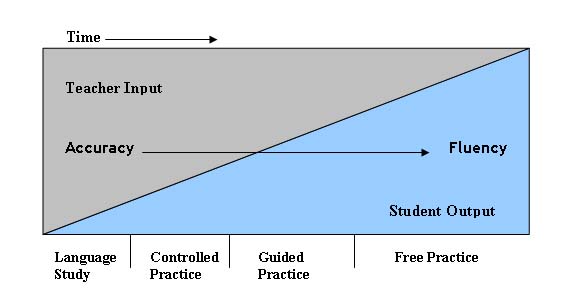
If you want to visualize this idea in practice, take a look at the graphic at the beginning of this post. The upper triangle represents teacher talk, which is always accurate; after all, she is usually a native speaker. The teacher begins class by talking (call this “teacher input”). However, the good teacher steadily reduces her own talk time by introducing activities that increase language production by her students (call this “student output.”) Conceptually, the class quickly changes from one in which the teacher does almost all the communication (focus on accuracy) to one in which the students do almost all the talking (focus on fluency).

As is always the case, a good language lesson should go through several stages as you make the transition from accuracy to fluency. It should begin with language study, then continue with activation of the language through controlled, guided and free practice exercises.

Forget about spending endless hours teaching grammar or having your students repeat sentence patterns by rote. Language acquisition takes place most effectively when your students use it in increasingly life-like situations. As the band leader said in auditions, “Don't play me the scales. Play me a damned tune!”

The focus on accuracy is strongest during the language study phase of class. Here the teacher explains some points of grammar, pronunciation or vocabulary, and does most (if not all) of the talking. There’s little possibility of error, because students don’t say much. This stage of the lesson is short, however.

Teachers need to structure their classes in such a way that they say less and less as class rolls on, while the students say more and more. When they do this, students become increasingly active in later stages of class, the “three practices”.

In controlled practice, the teacher remains in control. Student activities are such that it is fairly difficult for them to make errors – and when they do, the teacher’s job is to make corrections. At this stage, teacher input (also known as “teacher talk time”) is about equal to student output (“student talk time”). But student output completely dominates the latter parts of the class. The teacher relaxes control progressively during guided and free practice activities. Sure, your students will make mistakes, but their fluency will improve. And if you design your activities well, your students will correct each other or themselves when challenged.

I haven’t described all the components of an ideal lesson plan, of course. For example, good classes begin with a warm-up, which serves to switch on the students’ second language brains. They also include a stage often referred to as “engagement” – a few minutes of class in which the teacher catches student interest and generates excitement about the upcoming topic of study.

These notes are barely more than the sketch of a notion, but the basic idea is strong. Let accuracy go in the interest of fluency. If you do, the odds are you will see immediate improvements in your students’ classroom performance.

Friday, August 11, 2006

Confessions of a Language School Junkie


By Peter McKenzie-Brown

Many people in Thailand’s expat community teach English, and many more are learning Thai. Combined, they have more than a passing familiarity with the frustrations of language learning. But help may be at hand: “If you follow a few basic rules, you can take the ordeal out of language learning,” says Dr. Lynn Morris. The occasion was a presentation at Chiang Mai University (CMU), and Lynn called his talk “The Confessions of a Language School Junkie.”

An economist by training, during the last 12 years Lynn has studied five languages in seven countries at 15 different language schools. He only moved to Chiang Mai three years ago, but has already developed conversational fluency in Thai.

In his seminar, he offered ideas about language study from a learner’s perspective – and in his case, a learner with a bad memory. His audience included foreign students training to be English teachers in Thailand, and English instructors from CMU. Lynn’s presentation offered suggestions for learners based on his own experience and research. Noting that the great majority of language school students give up long before they reach conversational fluency, he stressed motivation above all. “Motivation matters.”

But suppose you are motivated. What can you do to speed up your language learning? You need to begin by understanding that most students study too little and try to learn too much. No one can realistically learn more than ten new words a day, for example, but learn new words you must. Says Lynn, “Vocabulary is king in language learning, and verbs are the queen. Ninety-nine percent of the time that I can’t do something in language, it’s because I don’t know the right word.” As a personal aid to his language study, he has created a system of vocabulary cards and voice recordings for pronunciation practice. Technically speaking, this system uses a principle known as anticipated graduated interval recall.

Lynn’s language regimen has five deceptively simple rules. First, “Repetition is the mother of mastery.” Use it. Another imperative is this: learn the most common words in your early days of language learning and move progressively on to those less frequently used. Third, get the pronunciation right. “If you can’t pronounce a word,” Lynn says, “you can’t memorize it.” Vowels are the biggest pronunciation problem for most people, so make this an area of special effort. Fourth, learn the vocabulary before you begin a reading practice. After all, reading exercises are about developing reading fluency rather than acquiring new words. Finally, spend 80 percent of your study time reviewing what you have already learned.

A vocabulary fetishist in every way, Lynn suggests that you can actually define the stages of language learning by word count. For example, a learner who has only mastered 500-1,000 English words can have no more than functional proficiency. By contrast, fluent conversation in social settings requires 3,000-8,000 words. And to understand TV news, read newspapers or participate in group conversation, you need 5,000-10,000 words. To put all this in context, an adult native speaker can typically use or recognize more than 20,000 words.

A rare few schools can teach languages quickly. America’s government-run Foreign Service Institute, for example, has supremely motivated students (career diplomats, military officers); highly expert instructors; and vast financial and training resources. Even with these enormous advantages, the FSI needs at least ten months to train an adult to work effectively in Thai.

By contrast, most language learners have limited resources and average teachers, so the period of mastery is much longer. Unlikely though it may seem after your first Thai lesson, however, there is no reason why a serious adult learner can’t become conversationally fluent. It just takes time and dedication.

Peter McKenzie-Brown is head TEFL instructor at Chiang Mai University’s Language Institute. This column is the first in a monthly series.

March 2003
Enhanced by Zemanta