Showing posts with label TEFL. Show all posts

Monday, October 09, 2006

The Stress-timed Rhythm of English


I recently updated my book, Teach and Learn: Reflections on Communicative Language Teaching, and made it available on Kindle and as an inexpensive paperback. To enjoy a read, please click here.


English is timed by the syllables we stress. It is thus irregular in rhythm.

By Peter McKenzie-Brown


Imagine yourself at public auditions in which four conductors are competing for the top job in an orchestra. Each competitor has to conduct the same piece of music, and each to the same metronome. As he waves his baton, the first conductor begins with the words, “One, two, three, four.” The second says “One and two and three and four.” The next says “One and a two and a three and a four.” And the last aspirant says “One and then a two and then a three and then a four.”

Which of these conductors will miscue the orchestra? The answer is “None.” Each of these four sentences takes exactly the same amount of time to say. This illustrates a key and yet peculiar feature of our language. It is called the stress-time rhythm of English.


Stress-timing: We can illustrate with almost any word of two or more syllables – for example, “syllable.” We stress this word using the pattern Ooo, placing primary emphasis on the first segment of the word. In English every long word has its own stress pattern. Think of the words “import” and “record,” for example. Both words can be pronounced using either the pattern Oo or the pattern oO. Which pattern you use fundamentally changes the meaning of the word.

Something else happens after you choose which syllable to stress. The pronunciation of the main vowel in the unstressed syllable changes, often to the sound ‘uh’ which is the single most common sound in the English language. This sound has its own special name, schwa, and about 30 per cent of the sounds we make when we speak English are the sound schwa. In English, schwa can be represented by any vowel.

For example, consider the following two-syllable words. The first word uses the stress patternOo; the second, the stress pattern oO. You will notice that in each case we pronounce the unstressed vowel as schwa, regardless of its spelling.

A: Atlas; Canoe
E: College; Reveal
I: Cousin; Disease
O: Anchor; Contain
U: Lettuce; Support


Statements with Noun Lists
Yes/No Questions
This practice of replacing unstressed vowels with schwa also occurs in connected speech – English as we use it in our daily lives. If I ask “Where are you from?” I will stress the word “from,” pronouncing the short ‘o’ sound quite clearly. If you answer “I’m from Sydney,” you will most likely reduce the ‘o’ to schwa. The reason is that you are likely to stress the word “Sydney” instead. This reduction of vowel is the key to the stress-timing of most forms of English.


It's worth noting that some English dialects from India, for example, are characterized by a syllable-timed rhythm. These comments refer to the English of Britain, North America  and Australia.

Native English speakers from those countries frequently use schwa in unstressed syllables. This is why it takes the same amount of time to say “One, two, three, four” as it does to say “One and then a two and then a three and then a four.” Reducing vowels enables us to speed through unstressed syllables. This is how we achieve the particular rhythm of English, in which stressed syllables are roughly equidistant in time, no matter how many syllables come in between.


Syllable-timed: Most of the world's other major languages have quite a different pattern. They are known as ‘syllable-timed’ languages. Each syllable receives approximately the same amount of stress as the others in a word or a sentence. These languages thus have quite a different rhythm from that of English. 

Vowels: When we learn to read, our teachers tell us that vowels are the characters a, e, i, o and u. Phonologically, though, a vowel is a speech sound in which the air stream from the lungs is not blocked in the mouth or throat. Usually, when we pronounce vowels we also vibrate our vocal cords.

We form the vowels in our mouths by moving five speech organs around. The most important of those organs is the tongue – language is the “gift of tongues” – and linguists often describe the vowels by the position of the tongue in the mouth. The vowels range from front to back and high to low. For example, the following ‘Sammy diagrams’ show the position of the tongue in the pronunciation of the high back vowel in the word “boot”, the low back vowel in the word “pot”, the high front vowel n the word “beat” and the low front vowel in the word “bat”.

The position of the tongue when we make vowel sounds is illustrated in the Sammies shown to the side and below.

Based on North American pronunciation, the words in the columns give examples of the 12 vowels in common use. Note that the vowel in “pot” is neither fully central nor fully back. The central vowels are essentially schwa, the sound that makes vowel possible.

In English, the high vowels, shifting from high to low, include the vowel sounds in beat, bit, bait, bet and bat. The central vowels are the mid vowels in machine and but. The back vowels, ranging from high to low, are in boot, book, boat and bought. The vowel in pot is an odd one. It is a low vowel, but it is neither fully central nor fully back.

The Sammy diagrams below, come from the book Teaching American English Pronunciation, by Peter Avery and Susan Ehrlich. So do the illustrations of how stress-timed language works.

Finally, a few graphics showing pronunciation patterns in North American English, also from Avery and Ehrlich.


Enhanced by Zemanta

Thursday, September 21, 2006

Living and Teaching in Thailand

By Peter McKenzie-Brown

This week it was a coup d'état. What next?!!!

My wife Bernie and I moved to Thailand from Canada several years ago just for the adventure. Well, adventure it has been, and we have enjoyed almost all of it! It’s a beautiful country, and we love living here.

We have observed the extraordinary economic development of the cities, and the growth of the middle class. However, we have also watched predations by government on the lives of Thai people. (We hope the peaceful coup will bring that to an end, but we have our doubts.) We have witnessed the desperate poverty of many people in hills and slums. And delightfully, we have also experienced the great kindness and gentleness of the Thai people.

Underlying all of this was my job as a teacher. I began teaching English, but today I teach visitors to Thailand how to teach English as a foreign language (TEFL). My work has brought stability into our lives, and it has brought us in touch with the Thai people. In Thai society, teachers are held in high esteem, and Thai students are a pleasure to have in class.

In this commentary I want to talk about living and teaching here, but also to offer a perspective on the country’s culture and politics. If the latter isn’t your thing, you can always stop reading!

Working in Thailand. I enjoyed a long corporate career before coming here. However, to get a job and a work permit in Thailand, before leaving Canada I took a one-year fulltime university program to get certification as a teacher of English as a second or other language (CERTESOL). That was a lot more than I needed, but it made it quite easy for me to get a job at Chiang Mai University (CMU) when I arrived. A year ago, I moved from the English Department to CMU’s Language Institute.

If you want to work in Thailand, TEFL accreditation is now required. You can get this from a number of places, although I personally think the TEFL course my colleague Karla M. Portch and I have developed is first rate. You will find many references to it on this blog.

Effective October 1 of this year, Thailand is putting severe restrictions on the right of foreigners to stay here indefinitely on tourist visas. As a result, becoming a long-term resident is now much more problematic. So, the other thing you need when you come here is a non-tourist visa – preferably a B (business) visa. If you can arrange that, it will be much easier to get a work permit.

If you have a TEFL certificate, you will be able to find work. Jobs are usually available at language schools, but they do not pay particularly well as long as you are a part-time teacher. Even small pay checks go a long way in this country, however, unless you want to enjoy a Western lifestyle.

As you gain experience, full-time opportunities can open up at language schools. They are also available in the public and private school systems, especially beginning at the end of May when the academic year begins. Chiang Mai alone is home to five universities, and many technical schools besides.

Also, many of our TEFL graduates find themselves teaching individuals or small groups of private clients. Most Thai people know the advantages of having English language skills, particularly because this country relies so heavily on the tourist trade. The demand for better English is great.

Living Here. Now settled, our lives seem normal. We think of Chiang Mai as just the place we live. Oddly, the ways we spend our days sometimes do not seem terribly different from when we lived in Canada -- different landscape, different language, different climate, different food and, yes, definitely a different pace of life! We have the occasional twinge of yearning for things more familiar, but that generally passes quickly.

Since we arrived here, we have witnessed all of life's rites of passage among our friends: marriage and divorce, birth and death. When a friend died a painful and lingering death from cancer a few months ago, it oddly created for us a special closeness to this city.

We are nearing the end of the rainy season, and we have had quite a bit of the wet stuff this year. In this part of Thailand the rains generally come for brief periods (often at night, when we are asleep), and are not at all disturbing. The rains are warm, and they keep the air clean and the vegetation lush and green. However, we don't travel a great deal during these months. But the dry, cool season begins in October. That's a great time for road trips.

A Recent Diary. A few weeks ago, Bernie and I went to a refugee camp at the Myanmar (Burma) border as part of my Rotary work. It was extraordinary to see again how different the two countries are. At one point we went to a temple whose landholdings were now, by international agreement, half on the Myanmar side of the border.

Once the border dispute was settled, the Myanmar authorities destroyed the village on their side and forced the Shan villagers to flee to Thailand. The army took over the concrete temple buildings and filled them with soldiers. The border now bristles with these people, who have also laid land mines just inside the border.

It's hard to believe the cruelty of the Burmese government to its ethnic (for example, Shan) minorities. This kind of thing is routine. On the positive side, a sort of "normal" life has been created in the refugee camp compliments of the Buddhist temple and an NGO.

The refugees now live in single-family bamboo huts. The kids receive a basic education at the temple, many of the women receive vocational training like dressmaking and crafts, and the men and some of the younger women go off to the fields to pick chillies or whatever else happens to be in season, for 10 baht (25 cents) per kilo. These people do not have Thai citizenship, so their movements are at the discretion of the Thai officials.

Who knows what the future holds for them? Well, at least for now they don't have to live in fear.

East Asian and Western World Views. While Thailand now has much of the feeling of home, the cultural differences are many, with Thais seeing the world quite differently from the way we view it in the West. Here are our quick summary and general observations: Westerners see things as rather black and white, while East Asians see them as heavily nuanced by relationships. Beliefs in the equality of man and in human rights are very real in the West. In East Asia, patron-client relationships are more important. And the immediate family is an incredibly powerful social unit.

In Thailand, one of the most extraordinary institutions is that of the monarchy. His Majesty King Bhumipol has been on the throne for 60 years, and the celebrations here have been great. It is quite hard for westerners to appreciate the reverence Thais have for their king. He's seen as simultaneously the embodiment of the Hindu god Vishnu (the preserver) and the incarnation of the Buddhist ideal of a king inspired by Dhamma (cosmic law). Thais believe without question that he can guide his people toward greater goodness, and his support of the recent coup was essential for it to succeed.

It is impossible to imagine how this country will ultimately respond to his death. Long may he reign!

The Coup. Like other westerners steeped in the traditions of democracy, I believe coups d'état are terrible. However, until the recent one occurred, the political situation here was an incredible mess. The country was running smoothly because of its efficient civil service. However, Thailand had not had a functioning government since February. That's when the prime minister and his cronies finally reached a level of corruption even Thailand couldn't handle. Although popular in rural Thailand, Thaksin Shinawatra was mostly despised by the middle class, intellectuals and the country’s elite.

There were weeks of mass protests and a rigged snap election that the opposition parties boycotted. The king called for the courts to settle the political controversy, and the results say a lot about the state of corruption at that time. The courts overturned the election and demanded a new one. The key members of the country's Election Commission were thrown in jail for their part in the travesty. It is unfortunate that the country did not have the political maturity to continue to rely on the courts to solve its problems. But perhaps the coup was the only viable solution. Who knows?

Final comment. There is still a great deal of blood being spilled in this country, but it is mostly limited to the three (Muslim) southernmost provinces. A tragic, shadowy insurgency began there nearly three years ago, and the previous government mishandled it from the start. People were being killed by both the terrorism of the insurgents and nastiness of the government, who waltzed over western concepts of human rights.

The recent coup offers some encouragement. The general in charge of the coup is a Muslim (such a thing has never happened before in this Buddhist country!) and he is known to be conciliatory. Perhaps the mess in Thailand’s Deep South can finally be resolved.

To my mind one of the biggest mysteries of this affair is how completely Thais seem to have accepted it. An extremely popular leader (at least, in rural areas) has been overthrown, yet the people have said nothing. Those I have spoken to seem to believe democracy is alive and well. Another common theme is that the king is safe and healthy, so why worry? Perhaps this just reflects how Thais view the world: after all, Buddhism teaches us to accept whatever happens.

Or perhaps they are afraid to express what they feel. The soldiers are serious about having taken power, and they will brook no interference.
Enhanced by Zemanta

Sunday, September 17, 2006

Words, Words, Words


I recently updated my book, Teach and Learn: Reflections on Communicative Language Teaching, and made it available on Kindle and as an inexpensive paperback. To enjoy a read, please click here.


By Peter McKenzie-Brown

You are studying a foreign language, you want to learn ten new words every day, and the mental task of managing your growing word list seems formidable. To put the job into context, consider the following from linguist Stephen Pinker.

“Children begin to learn words before their first birthday,” he says, “and by their second they hoover them up at a rate of one every two hours. By the time they enter school children command 13,000 words, and then the pace picks up, because new words rain down on them from both speech and print. A typical high-school graduate knows about 60,000 words; a literate adult, perhaps twice that number.”

Smaller than a toddler’s daily intake, your ten-word vocabulary list suddenly seems like a pauper in a palace. And the problem of properly learning vocabulary involves much more than remembering words. In the classroom, only a few words and a small part of what the learner needs to know about a word can be dealt with at any one time. For the common words, which often have multiple meanings and complex nuances, you can only teach a bit at a time. The more information you present, the more likely your learners are to misunderstand.

For both teacher and learner, vocabulary is a huge challenge. But help is at hand from vocabulary researcher Paul Nation, whose magisterial 480-page tome, Learning Vocabulary in Another Language, offers endless insights into the science and practice of teaching and learning vocabulary. He calls his preferred method of vocabulary teaching the direct approach.

Nation describes vocabulary learning as a “meeting” between the learner and the word, and he stresses that it only makes sense to have close encounters with common, useful words. Most teachers emphasize the most common 2000 English words. The most widely accepted list is available on the Internet by googling Michael West’s General Service List.

“Useful vocabulary needs to be met again and again to ensure it is learned,” Nation says. “In the early stages of learning the meetings need to be reasonably close together, preferably within a few days, so that too much forgetting does not occur. Later meetings can be very widely spaced with several weeks between each meeting.”

There are essentially four ways to learn and teach high-frequency words.
• One is direct teaching, mentioned earlier. For the language teacher, explaining vocabulary is a critical part of classroom duties.
• Also, encourage your students to participate in direct learning, which involves study from word cards and dictionary use.
• A third method, incidental learning, can involve guessing from context in extensive reading or through word use in communicative activities.
• The fourth method Nation calls “planned encounters.” These encounters include vocabulary exercises and graded reading – that is, using reading materials like shortened novels with reduced vocabulary for language learners.(Graded readers are available in many language teaching bookstores.)

Nation’s direct approach to vocabulary teaching is built upon three main ideas. First, vocabulary teaching should focus on high-frequency words that will be of continuing importance for the learners. As a teacher, you have a duty to pass over low-frequency words completely or with little comment. Also, you have to make sure the learners come back to the word frequently, to diminish the power of forgetfulness.

Also, when you teach a word you should focus on its “learning burden” – that is, the features of the word that actually need to be taught. These can differ quite dramatically from word to word. Take the word “think.” You need to explain that it is an irregular verb; that it includes the irregular spelling “thought”; and that “thought” can also be a noun.

Finally, direct teaching should be clear and simple. To learn a word in all its complexity, learners need to meet it many times. Don’t try to teach a complex word – for example, the many meanings of the word “right” – in one sitting. That kind of intensive vocabulary teaching takes place in boring classrooms, and it frequently leads to perplexed students.
Enhanced by Zemanta

Thursday, August 31, 2006

The Krashen Revolution


By Peter McKenzie-Brown

About 25 years ago, a psychologist named Stephen Krashen transformed language teaching. He had been developing his ideas over a number of years, but several books he published in the 1980s received widespread acceptance. They quickly became the most widely accepted way to explain the twin processes of language teaching and learning. Also, with Tracey Terrell, he developed the natural approach to language teaching. One of his books is available on the web.

Much has been made of Krashen's theory of second language acquisition, which consists of five main hypotheses: The acquisition-learning hypothesis, the monitor hypothesis, the natural order hypothesis, the input hypothesis, and the affective filter hypothesis. Before we turn to these ideas, though, it is worth noting that by no means do they pertain exclusively to second language acquisition. As you read the following explanation of Krashen's five hypotheses, ask yourself whether his ideas are not equally applicable to an individual who has only one language. It seems to me that Krashen's ideas work equally well to describe how an adult native-speaker would improve her English, say, as they do to describe the process for the second language learner.

The Natural Order Hypothesis. Based on a powerful analysis of research results, Krashen’s natural order hypothesis suggests that the acquisition of language, especially the rules of language, follows a predictable natural order. For any given language, some grammatical structures tend to be acquired earlier than others. This idea reflects Noam Chomsky’s revolutionary notion that we all have a built-in Language Acquisition Device (LAD), which within the first year of our lives begins to enable us to understand and acquire language.

Because of the nature of the LAD, we tend to learn different structures at different levels as young children. Researchers have found that the same pattern occurs for older learners – not a surprise to seasoned language teachers! This is the “predictable natural order” of this hypothesis.

The Acquisition/Learning Hypothesis. The distinction between acquisition and learning is the most fundamental of all the hypotheses in Krashen's theory, since it suggests that language comes to us in two rather different ways. Acquisition is one. You acquire language by using it for real communication. Learning, which he describes as “knowing about” language, is quite a different thing.

Acquisition is the product of a subconscious process very similar to the process children undergo when they acquire their first language. It requires meaningful interaction in the target language - natural communication - in which speakers concentrate not on the form of their utterances, but in the communicative act. Learning, on the other hand, provides conscious knowledge “about” the target language. It is therefore less important than acquisition for basic communication, but it still plays an important role in language learning. To oversimplify a bit, learning is likely to occur in the “study” segment of an English lesson, while acquisition takes places during language activation.

The Monitor Hypothesis. The fundamental distinction between acquisition and learning leads directly to the next hypothesis. The monitor hypothesis relegates language learning (that is, a student’s responses to what the teacher teaches) to a secondary place in the scheme of language learning.

The monitor hypothesis is the idea that conscious learning – that is, the outcome of grammar instruction and other activities that were the traditional stock in trade of the language teacher – serve only as a monitor or an editor for the language student. Real acquisition takes place as “meaningful interaction in the target language – natural communication – in which speakers are concerned not with the form of their utterances but with the messages they are conveying and understanding.”

The Input Hypothesis. The input hypothesis suggests that people acquire language in only one way: by understanding messages, or by receiving ‘comprehensible input’. According to the input hypothesis, learner’s progress by receiving second language input that is one step beyond their current stage of linguistic competence. Acquisition for learners with language knowledge “i” can only take place if they are exposed to comprehensible input at a slightly higher level, which Krashen describes as level “i + 1”.

The Affective Filter Hypothesis. Finally, the Affective Filter Hypothesis proposes that a mental block caused by affective or emotional factors can prevent input from reaching the student’s language acquisition device. The affective filter hypothesis says that affective variables like self-confidence and anxiety play a role in language acquisition. When the filter is up – that is, when negative emotional factors are in play – language acquisition suffers. When the filter is down, it benefits.

Taken together, these hypotheses offer a practical, elegant and appealing theory of language acquisition and learning.

Putting Krashen’s Ideas to Use.
Tracy Terrell worked with Krashen to create the nuts-and-bolts practical applications of the natural approach. He borrowed widely from many methods, adapting them to meet the requirements of natural approach theory. “What characterizes the Natural Approach is the use of familiar techniques within the framework of a method that focuses on providing comprehensible input and a classroom environment that uses comprehension of input, minimizes learner anxiety, and maximizes learner self-confidence.”

He held students to a high level of accountability. They must be clear about their goals, take active roles in ensuring that input is comprehensible, make decisions about when to start producing speech, and even contribute to choices about the amount of time to be spent on grammar, for example. The teacher is a central figure in the natural approach classroom, however – the primary source of comprehensible input, and responsible for creating a friendly and encouraging class atmosphere. Also, of course, the teacher must find and introduce a rich mix of classroom activities to make the approach work.

The focus is always on introducing a little more English usage to what the students already have – i + 1, in Krashen’s formulation, – and to do so in a warm and receptive classroom. The method makes wide use of realia, props and visuals (typically magazine pictures) to introduce new vocabulary and practice comprehensible input.
Enhanced by Zemanta

Saturday, August 26, 2006

How Persnickety Should the Teacher Be?


By Peter McKenzie-Brown


There are endless debates among language teachers about how concerned teachers should be with their students’ language output. What is the best balance between the extremes of correcting most of their errors and correcting none? Do we want students to speak accurately, even if doing so limits their ability to use the language easily? Or do we want them to speak more comfortably (that is, fluently), even at the expense of accurate pronunciation and grammar? How persnickety should the teacher be?

There will always be battles between advocates of accuracy and advocates of fluency. However, most Western language teachers now fall into the latter camp, and they are supported by a large body of research and language theory. According to this point of view, there is in inevitable lag between language fluency and language accuracy. As language learners develop greater comfort in using a second language, they become better able to identify and correct their own mistakes. I believe this principle should dominate language acquisition.

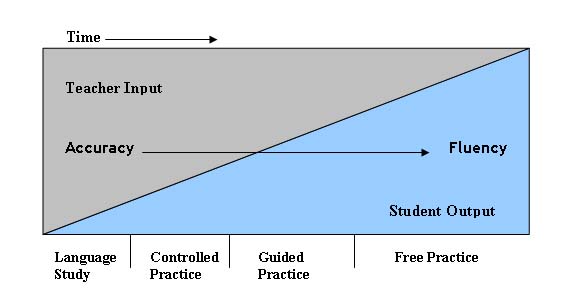
If you want to visualize this idea in practice, take a look at the graphic at the beginning of this post. The upper triangle represents teacher talk, which is always accurate; after all, she is usually a native speaker. The teacher begins class by talking (call this “teacher input”). However, the good teacher steadily reduces her own talk time by introducing activities that increase language production by her students (call this “student output.”) Conceptually, the class quickly changes from one in which the teacher does almost all the communication (focus on accuracy) to one in which the students do almost all the talking (focus on fluency).

As is always the case, a good language lesson should go through several stages as you make the transition from accuracy to fluency. It should begin with language study, then continue with activation of the language through controlled, guided and free practice exercises.

Forget about spending endless hours teaching grammar or having your students repeat sentence patterns by rote. Language acquisition takes place most effectively when your students use it in increasingly life-like situations. As the band leader said in auditions, “Don't play me the scales. Play me a damned tune!”

The focus on accuracy is strongest during the language study phase of class. Here the teacher explains some points of grammar, pronunciation or vocabulary, and does most (if not all) of the talking. There’s little possibility of error, because students don’t say much. This stage of the lesson is short, however.

Teachers need to structure their classes in such a way that they say less and less as class rolls on, while the students say more and more. When they do this, students become increasingly active in later stages of class, the “three practices”.

In controlled practice, the teacher remains in control. Student activities are such that it is fairly difficult for them to make errors – and when they do, the teacher’s job is to make corrections. At this stage, teacher input (also known as “teacher talk time”) is about equal to student output (“student talk time”). But student output completely dominates the latter parts of the class. The teacher relaxes control progressively during guided and free practice activities. Sure, your students will make mistakes, but their fluency will improve. And if you design your activities well, your students will correct each other or themselves when challenged.

I haven’t described all the components of an ideal lesson plan, of course. For example, good classes begin with a warm-up, which serves to switch on the students’ second language brains. They also include a stage often referred to as “engagement” – a few minutes of class in which the teacher catches student interest and generates excitement about the upcoming topic of study.

These notes are barely more than the sketch of a notion, but the basic idea is strong. Let accuracy go in the interest of fluency. If you do, the odds are you will see immediate improvements in your students’ classroom performance.

Sunday, August 20, 2006

Noam Chomsky's Black Box


I recently updated my book, Teach and Learn: Reflections on Communicative Language Teaching, and made it available on Kindle and as an inexpensive paperback. To enjoy a read, please click here.


By Peter McKenzie-Brown


What is language, and where does it come from? The answer to this question has great bearing on how we teach language.

Before the coming of Communicative Language Teaching, most thinkers believed that behaviourism – a powerful approach to psychology – explained language. In effect, according to this view, language is a set of habits we develop through mimicry of our parents and those around us.

We learn language because it brings us a reward of some kind. The basic model these thinkers – led by B.F. Skinner, a renowned Harvard psychologist – used to explain psychological phenomena is a simple one. If an organism responds in a certain way to a stimulus and gets positive reinforcement, its behaviour will be repeated. If it gets no reinforcement or negative reinforcement, its behaviour will stop. Thus, any kind of vocal output can become part of language, given sufficient reinforcement.

This model of language learning had a powerful impact on the teaching method known as audiolingualism. This method was based on the belief that language learning is basically a process of mechanical habit formation. It placed a strong focus on drills, on teaching through speech at the expense of the other skills, on inductive teaching (repeating a structure many times, then deciding for yourself how the grammar works) and on learning vocabulary within a linguistic and cultural context. This approach is still widely used in East Asia.

In effect, behaviourism denied the concept of human nature. It taught that people can be made to become almost anything, given the right sequence of stimuli and responses. On the matter of language, the logical conclusion was that there were no limitations to what language could be. Any linguistic habit that people somehow developed could become part of language. In academic circles these notions were widely accepted until Noam Chomsky turned them upside down.

The Language Instinct: In a famous phrase, Chomsky said he wanted to "look deeper" into some basic questions about human language. His early theoretical books and papers gave his answer to an extremely profound question: Is language infinitely changeable (the basis of audio-lingualism), or are all languages in some way a part of being human? In the following passage, one of Chomsky’s best-known admirers summarizes the thinker’s basic conclusions:

Language is a human instinct. All societies have complex language, and everywhere the languages use the same kinds of grammatical machinery like nouns, verbs, auxiliaries, and agreement. All normal children develop language without conscious effort or formal lessons, and by the age of three they speak in fluent grammatical sentences, outperforming the most sophisticated computers. Brain damage or congenital conditions can make a person a linguistic savant while severely retarded, or unable to speak normally despite high intelligence. All this has led many scientists, beginning with the linguist Noam Chomsky in the late 1950s, to conclude that there are specialized circuits in the human brain, and perhaps specialized genes, that create the gift of articulate speech.

Chomsky’s ideas explained the facts in a way that no other theory can. Acquiring language is not a normal mental problem. Everyone sees small children pick up language effortlessly. But few of us ever give a thought to what an amazing phenomenon this is. No one would expect a three-year-old to master calculus. Yet we are not in the least surprised when a three-year-old learns grammar, which is a much more difficult task. Children learn the rules of their native grammar (whatever it might be) by hearing a limited set of sample sentences. According to Chomsky's followers, the limited information they receive is mathematically insufficient for them to determine grammatical principles, yet somehow they are still able to do so. This is what is sometimes called “The paradox of language acquisition”. As Chomsky explained,
In a given linguistic community, children with very different grammar arrive at comparable grammars, indeed almost identical ones, as far as we know. That is what requires explanation. Each child has a different experience, each child is confronted by different data – but in the end the experience is essentially the same. As a consequence, we have to suppose that all children share the same internal constraints which characterize narrowly the grammar they are going to construct.


Chomsky proposed that each of us has a Language Acquisition Device (LAD) – what he sometimes called a “little black box” – that starts functioning when we are still infants. By the time we are five or six, that device has enabled us to vacuum from our immediate environment a native language based on universal grammar. Put another way, all languages are fundamentally the same, irrespective of the cultures we live in. They are the function of a large number of words (arbitrary symbols whose meaning is set by convention) and a limited number of grammatical rules that are somehow structured into our brains and minds.

Those who learn during the “critical period” – roughly, during early childhood – acquire language without effort. However, our little black boxes begin to function in different ways after we reach six years of age. We remain able to acquire language fairly easily until we reach puberty, after which our ability to acquire language seems to be reduced again.

Older learners must therefore learn languages in quite different ways from the effortless acquisition of young children. The ways in which language acquisition changes form are of vital importance to language teachers.

A helpful book in this area of study is How Languages Are Learned by academics Patsy M. Lightbown and Nina Spada. The two educational psychologists offer useful insights into the differences in learning styles. They say, “We have all heard people say that they cannot learn something until they have seen it. Such learners would fall into the group called ‘visual learners.’ Other people, who may be called ‘aural’ learners, seem to need only to hear something once or twice before they know it. For others, who are referred to as ‘kinaesthetic’ learners, there is a need to add a physical action to the learning process.”

These ideas are common in teaching circles. However, Lightbown and Spada go on to discuss two learning styles that are highly cultural in nature. “In contrast to these perceptually based learning styles, [there is] a cognitive learning style distinction between field independent and field dependent learners. This refers to whether an individual tends to separate details from the general background or to see things more holistically.” In general, westerners, who tend to see things as black or white, are field independent. By contrast, East Asians are field dependent inasmuch as they see things as part of a large mingling of relationships.

In their challenging text, Lightbown and Spada describe three theories about how we acquire our first language. The most important of those theories, innatism and behaviourism are covered at the beginning of this essay. A third approach is called interactionism.

The interactionist position is that “language develops as a result of the complex interplay between the uniquely human characteristics of the child and the environment in which the child develops.” A kind of umbrella that covers several different kinds of language theories, contemporary interactionism assumes the validity of Chomsky’s idea that innate structures in the mind are responsible for language learning, but has a variety of questions about the contributions of environmental factors to language learning.

In a summary of these questions, the authors propose that behaviourism may help explain our acquisition of vocabulary and other parts of grammar. For its part, innatism seems “most plausible in explaining the acquisition of complex grammar.” And “interactionist explanations may be useful for understanding how children relate form and meaning in language, how they interact in conversations, and how they learn to use language appropriately.”
Enhanced by Zemanta

Friday, August 11, 2006

Confessions of a Language School Junkie


By Peter McKenzie-Brown

Many people in Thailand’s expat community teach English, and many more are learning Thai. Combined, they have more than a passing familiarity with the frustrations of language learning. But help may be at hand: “If you follow a few basic rules, you can take the ordeal out of language learning,” says Dr. Lynn Morris. The occasion was a presentation at Chiang Mai University (CMU), and Lynn called his talk “The Confessions of a Language School Junkie.”

An economist by training, during the last 12 years Lynn has studied five languages in seven countries at 15 different language schools. He only moved to Chiang Mai three years ago, but has already developed conversational fluency in Thai.

In his seminar, he offered ideas about language study from a learner’s perspective – and in his case, a learner with a bad memory. His audience included foreign students training to be English teachers in Thailand, and English instructors from CMU. Lynn’s presentation offered suggestions for learners based on his own experience and research. Noting that the great majority of language school students give up long before they reach conversational fluency, he stressed motivation above all. “Motivation matters.”

But suppose you are motivated. What can you do to speed up your language learning? You need to begin by understanding that most students study too little and try to learn too much. No one can realistically learn more than ten new words a day, for example, but learn new words you must. Says Lynn, “Vocabulary is king in language learning, and verbs are the queen. Ninety-nine percent of the time that I can’t do something in language, it’s because I don’t know the right word.” As a personal aid to his language study, he has created a system of vocabulary cards and voice recordings for pronunciation practice. Technically speaking, this system uses a principle known as anticipated graduated interval recall.

Lynn’s language regimen has five deceptively simple rules. First, “Repetition is the mother of mastery.” Use it. Another imperative is this: learn the most common words in your early days of language learning and move progressively on to those less frequently used. Third, get the pronunciation right. “If you can’t pronounce a word,” Lynn says, “you can’t memorize it.” Vowels are the biggest pronunciation problem for most people, so make this an area of special effort. Fourth, learn the vocabulary before you begin a reading practice. After all, reading exercises are about developing reading fluency rather than acquiring new words. Finally, spend 80 percent of your study time reviewing what you have already learned.

A vocabulary fetishist in every way, Lynn suggests that you can actually define the stages of language learning by word count. For example, a learner who has only mastered 500-1,000 English words can have no more than functional proficiency. By contrast, fluent conversation in social settings requires 3,000-8,000 words. And to understand TV news, read newspapers or participate in group conversation, you need 5,000-10,000 words. To put all this in context, an adult native speaker can typically use or recognize more than 20,000 words.

A rare few schools can teach languages quickly. America’s government-run Foreign Service Institute, for example, has supremely motivated students (career diplomats, military officers); highly expert instructors; and vast financial and training resources. Even with these enormous advantages, the FSI needs at least ten months to train an adult to work effectively in Thai.

By contrast, most language learners have limited resources and average teachers, so the period of mastery is much longer. Unlikely though it may seem after your first Thai lesson, however, there is no reason why a serious adult learner can’t become conversationally fluent. It just takes time and dedication.

Peter McKenzie-Brown is head TEFL instructor at Chiang Mai University’s Language Institute. This column is the first in a monthly series.

March 2003
Enhanced by Zemanta